Administrative Order 11-2021 adopted September 1, 2021, and effective September 1, 2022
Rule adoption history
Oregon-initiated rules appear in italics.
Division 2 contains Oregon-initiated rules and rules adopted by reference from the Code of Federal Regulations (CFR). A description of rule structure is available.
Start Oregon-initiated rule.
437-002-0280 Adoption by Reference
In addition to, and not in lieu of, any other safety and health codes contained in OAR Chapter 437, the Department adopts by reference the following federal regulations printed as part of the Code of Federal Regulations, 29 CFR 1910, in the Federal Register:
437-002-0280 (1) 29 CFR 1910.251 Definitions. Repealed. Oregon OSHA Admin. Order 6-2014, filed 10/28/2014, effective 5/1/2015. In Oregon, OAR 437-002-0299 applies.
437-002-0280 (2) 29 CFR 1910.252 General Requirements, published 3/26/12, FR vol. 77, no. 58, p. 17574. Amended with Oregon OSHA Administrative Order 11-2021.
437-002-0280 (3) 29 CFR 1910.253 Oxygen-Fuel Gas Welding and Cutting. Repealed. Oregon OSHA Admin. Order 6-2014, filed 10/28/2014, effective 5/1/2015. In Oregon, OAR 437-002-2253 applies.
437-002-0280 (4) 29 CFR 1910.254 Arc Welding and Cutting, published 9/13/05, FR vol. 70, no. 176, p. 53925.
437-002-0280 (5) 29 CFR 1910.255 Resistance Welding, published 4/11/90, Federal Register, vol. 55, no. 70, pp. 13710-13711.
These rules are on file with the Oregon Occupational Safety and Health Division, Oregon Department of Consumer and Business Services, and the United States Government Printing Office.
Statutory Authority: ORS 654.025(2),654.035 and ORS 656.726(4).
Statutes Implemented: ORS 654.001 through 654.295.
History:
OSHA Administrative Order 23-1990, filed 9/28/1990, effective 12/1/1990.
OSHA Administrative Order 4-1997, filed 4/2/1997, effective 4/2/1997.
OSHA Administrative Order 3-1998, filed 7/7/1998, effective 7/7/1998.
OSHA Administrative Order 4-2005, filed 12/14/2005, effective 12/14/2005.
OSHA Administrative Order 7-2008, filed 5/30/2008, effective 5/30/2008.
OSHA Administrative Order 2-2010, filed 2/25/2010, effective 2/25/2010.
OSHA Administrative Order 1-2012, filed 4/10/2012, effective 4/10/2012.
OSHA Administrative Order 5-2012, filed 9/25/2012, effective 9/25/2012.
OSHA Administrative Order 6-2014, filed 10/28/2014, effective 5/1/2015.
OSHA Administrative Order 11-2021, filed 9/1/2021 effective 9/1/2022.
End Oregon-initiated rule.
Start Oregon-initiated rule.
437-002-0299 Definitions
437-002-0299 (1) Terms used in Division 2/Q
437-002-0299 (1)(a) Approved: listed or approved by a nationally recognized testing laboratory (NRTL).
Note: 1910.7 has NRTL requirements.
437-002-0299 (1)(b) Coated steels: include metal coated to provide a protective covering such as to prevent rusting or to shield the metal from chemicals. Protective coatings can contain chromium, lead, tin, zinc or other potentially hazardous materials. During hot work, the coatings can give off fumes, smoke, or dust. Welders must know what a coating can give off when heated or burned. This information is available on the manufacturers' Safety Data Sheets. Permissible Exposure Limits for these materials must not be exceeded.
437-002-0299 (1)(c) Competent person: a person capable of identifying existing and predictable hazards in the work environment which are unsanitary, hazardous, or dangerous to employees; and who has authorization to take prompt corrective measures to eliminate these hazards.
437-002-0299 (1)(d) Confined space: As defined in OAR 437-002-0146, a space that meets all of the following:
437-002-0299 (1)(d)(A) Large enough and so configured that an employee can fully enter the space and perform work.
437-002-0299 (1)(d)(B) Has limited or restricted means for entry or exit.
437-002-0299 (1)(d)(C) Is not designed for continuous human occupancy.
437-002-0299 (1)(e) Feasible: In this context, something that is possible or capable of being done and that effectively accomplishes the goal of protecting employees.
437-002-0299 (1)(f) Hot work activities: include welding, torch-cutting, brazing and any similar activity that produces heat or a source of ignition.
437-002-0299 (1)(g) Toxic substance or harmful physical agent: As defined in 1910.1020, any chemical substance, biological agent (bacteria, virus, fungus, etc.), or physical stress (noise, heat, cold, vibration, repetitive motion, ionizing and non-ionizing radiation, hypo- or hyperbaric pressure, etc.) which:
437-002-0299 (1)(g)(A) Is listed in the latest printed edition of the National Institute for Occupational Safety and Health (NIOSH) Registry of Toxic Effects of Chemical Substances (RTECS); or
437-002-0299 (1)(g)(B) Has yielded positive evidence of an acute or chronic health hazard in testing conducted by, or known to, the employer; or
437-002-0299 (1)(g)(C) Is the subject of a safety data sheet kept by or known to the employer indicating that the material may pose a hazard to human health.
437-002-0299 (2) Welding, cutting or grinding tasks referenced in Table OR Q-2:
437-002-0299 (2)(a) Carbon Arcing - or carbon gouging -- is an arc cutting process in which metals to be cut are melted by the heat of the carbon arc and the molten metal is removed by a blast of air.
437-002-0299 (2)(b) Flux-Cored Arc Welding (FCAW) -- or FCA or MIG flux core welding -- is an automatic or semi-automatic arc welding process requiring a continuously fed consumable tubular electrode containing a flux. (Shielding gas is often not needed; but a constant welding current or power supply is required.)
437-002-0299 (2)(c) Gas Metal Arc Welding (GMAW) - or MIG Solid Wire uses a spooled, solid steel wire fed through a welding lead to the welding gun.
437-002-0299 (2)(d) Gas Tungsten Arc Welding (GTAW) -- or Tungsten Inert Gas -- TIG Welding (also called "Heliarc" welding) uses a non-consumable tungsten electrode to produce the weld and an inert gas to shield the weld from the atmosphere.
437-002-0299 (2)(e) Grinding tasks directly related to the welding process include the preparation of metal surfaces such as the removal of coatings, rust, or oxidation; and beveling or otherwise reducing the thickness at the edge of the metal to be joined by welding.
437-002-0299 (2)(f) Hand-held means any welding or cutting process where the torch or electrode holder is manipulated by hand.
437-002-0299 (2)(g) Torch cutting includes heating the metal with a torch flame until it is red, then using a blast trigger to deliver a higher concentration of oxygen that forces the molten metal away, creating a cut.
437-002-0299 (2)(h) Plasma Cutting uses a high-intensity plasma arc to melt a very narrow area that pushes through the work piece and removes the molten metal.
437-002-0299 (2)(i) Shielded Metal Arc Welding (SMAW) - also called "stick" welding -- uses a stick-type electrode core covered by chemical or metallic materials that provide shielding from surrounding air to complete an electrical circuit. Typically, a holder keeps the electrode at a chosen angle.
437-002-0299 (3) Notes about the recommended "Standard order for atmospheric testing" in a confined or other enclosed space:
437-002-0299 (3)(a) Before workers are allowed to enter confined and enclosed spaces, and at sufficient intervals to ensure safe conditions, a person competent in the use of atmospheric testing equipment may be required to test the atmosphere.
437-002-0299 (3)(b) The following is considered the standard order of testing and provides guidelines for ranges of concentration that are recognized as safe:
437-002-0299 (3)(b)(A) Oxygen. To support life, Oxygen content levels must be maintained at or above 19.5% and below 22.0% by volume. (Above 22.0% by volume is an "oxygen-enriched atmosphere with additional safety hazards for fire and explosion.) If an oxygen-deficient or oxygen-enriched atmosphere is found, ventilation must be provided at volumes and flow rates sufficient to restore oxygen content to the safe range.
437-002-0299 (3)(b)(B) Flammable gases/ vapors. The concentration of flammable gasses or vapors must be maintained below 10% of the Lower Explosive Limit (LEL).
437-002-0299 (3)(b)(C) Toxic vapors. The types of toxic gases, vapors, or fumes present will depend on the types of materials being worked on and worked with. These air contaminants must be maintained below the OSHA permissible exposure limits (PELs). If there is no established OSHA PEL, the levels must be maintained below the NIOSH immediately dangerous to life and health (IDLH) level. Local exhaust ventilation can remove these contaminants at their source while general exhaust ventilation -- provided at sufficient volumes and flow rates -- can restore concentrations to safe levels.
Statutory/Other Authority: ORS 654.025(2), 654.035 & 656.726(4)
Statutes/Other Implemented: ORS 654.001 through 654.295
History:
OSHA Administrative Order 11-2021, filed 9/1/2021 effective 9/1/2022.
End Oregon-initiated rule.
1910.252 General Requirements
1910.252 (a) Fire prevention and protection.
1910.252 (a)(1) Basic precautions. For elaboration of these basic precautions and of the special precautions of paragraph (a)(2) of this section as well as a delineation of the fire protection and prevention responsibilities of welders and cutters, their supervisors (including outside contractors) and those in management on whose property cutting and welding is to be performed, see Standard for Fire Prevention in Use of Cutting and Welding Processes, NFPA Standard 51B, 1962, which is incorporated by reference as specified in 1910.6. The basic precautions for fire prevention in welding or cutting work are:
1910.252 (a)(1)(i) Fire hazards. If the object to be welded or cut cannot readily be moved, all movable fire hazards in the vicinity shall be taken to a safe place.
1910.252 (a)(1)(ii) Guards. If the object to be welded or cut cannot be moved and if all the fire hazards cannot be removed, then guards shall be used to confine the heat, sparks, and slag, and to protect the immovable fire hazards.
1910.252 (a)(1)(iii) Restrictions. If the requirements stated in paragraphs (a)(1)(i) and (a)(1)(ii) of this section cannot be followed then welding and cutting shall not be performed.
1910.252 (a)(2) Special precautions. When the nature of the work to be performed falls within the scope of paragraph (a)(1)(ii) of this section certain additional precautions may be necessary:
1910.252 (a)(2)(i) Combustible material. Wherever there are floor openings or cracks in the flooring that cannot be closed, precautions shall be taken so that no readily combustible materials on the floor below will be exposed to sparks which might drop through the floor. The same precautions shall be observed with regard to cracks or holes in walls, open doorways and open or broken windows.
1910.252 (a)(2)(ii) Fire extinguishers. Suitable fire extinguishing equipment shall be maintained in a state of readiness for instant use. Such equipment may consist of pails of water, buckets of sand, hose or portable extinguishers depending upon the nature and quantity of the combustible material exposed.
1910.252 (a)(2)(iii) Fire watch.
1910.252 (a)(2)(iii)(A) Fire watchers shall be required whenever welding or cutting is performed in locations where other than a minor fire might develop, or any of the following conditions exist:
1910.252 (a)(2)(iii)(A)(1) Appreciable combustible material, in building construction or contents, closer than 35 feet (10.7 m) to the point of operation.
1910.252 (a)(2)(iii)(A)(2) Appreciable combustibles are more than 35 feet (10.7 m) away but are easily ignited by sparks.
1910.252 (a)(2)(iii)(A)(3) Wall or floor openings within a 35-foot (10.7 m) radius expose combustible material in adjacent areas including concealed spaces in walls or floors.
1910.252 (a)(2)(iii)(A)(4) Combustible materials are adjacent to the opposite side of metal partitions, walls, ceilings, or roofs and are likely to be ignited by conduction or radiation.
1910.252 (a)(2)(iii)(B) Fire watchers shall have fire extinguishing equipment readily available and be trained in its use. They shall be familiar with facilities for sounding an alarm in the event of a fire. They shall watch for fires in all exposed areas, try to extinguish them only when obviously within the capacity of the equipment available, or otherwise sound the alarm. A fire watch shall be maintained for at least a half hour after completion of welding or cutting operations to detect and extinguish possible smoldering fires.
1910.252 (a)(2)(iv) Authorization. Before cutting or welding is permitted, the area shall be inspected by the individual responsible for authorizing cutting and welding operations. He shall designate precautions to be followed in granting authorization to proceed preferably in the form of a written permit.
1910.252 (a)(2)(v) Floors. Where combustible materials such as paper clippings, wood shavings, or textile fibers are on the floor, the floor shall be swept clean for a radius of 35 feet (10.7 m). Combustible floors shall be kept wet, covered with damp sand, or protected by fire-resistant shields. Where floors have been wet down, personnel operating arc welding or cutting equipment shall be protected from possible shock.
1910.252 (a)(2)(vi) Prohibited areas. Cutting or welding shall not be permitted in the following situations:
1910.252 (a)(2)(vi)(A) In areas not authorized by management.
1910.252 (a)(2)(vi)(B) In sprinklered buildings while such protection is impaired.
1910.252 (a)(2)(vi)(C) In the presence of explosive atmospheres (mixtures of flammable gases, vapors, liquids, or dusts with air), or explosive atmospheres that may develop inside uncleaned or improperly prepared tanks or equipment which have previously contained such materials, or that may develop in areas with an accumulation of combustible dusts.
1910.252 (a)(2)(vi)(D) In areas near the storage of large quantities of exposed, readily ignitable materials such as bulk sulfur, baled paper, or cotton.
1910.252 (a)(2)(vii) Relocation of combustibles. Where practicable, all combustibles shall be relocated at least 35 feet (10.7 m) from the work site. Where relocation is impracticable, combustibles shall be protected with flameproofed covers or otherwise shielded with metal or asbestos guards or curtains.
1910.252 (a)(2)(viii) Ducts. Ducts and conveyor systems that might carry sparks to distant combustibles shall be suitably protected or shut down.
1910.252 (a)(2)(ix) Combustible walls. Where cutting or welding is done near walls, partitions, ceiling or roof of combustible construction, fire-resistant shields or guards shall be provided to prevent ignition.
1910.252 (a)(2)(x) Noncombustible walls. If welding is to be done on a metal wall, partition, ceiling or roof, precautions shall be taken to prevent ignition of combustibles on the other side, due to conduction or radiation, preferably by relocating combustibles. Where combustibles are not relocated, a fire watch on the opposite side from the work shall be provided.
1910.252 (a)(2)(xi) Combustible cover. Welding shall not be attempted on a metal partition, wall, ceiling or roof having a combustible covering nor on walls or partitions of combustible sandwich-type panel construction.
1910.252 (a)(2)(xii) Pipes. Cutting or welding on pipes or other metal in contact with combustible walls, partitions, ceilings or roofs shall not be undertaken if the work is close enough to cause ignition by conduction.
1910.252 (a)(2)(xiii) Management. Management shall recognize its responsibility for the safe usage of cutting and welding equipment on its property and:
1910.252 (a)(2)(xiii)(A) Based on fire potentials of plant facilities, establish areas for cutting and welding, and establish procedures for cutting and welding, in other areas.
1910.252 (a)(2)(xiii)(B) Designate an individual responsible for authorizing cutting and welding operations in areas not specifically designed for such processes.
1910.252 (a)(2)(xiii)(C) Insist that cutters or welders and their supervisors are suitably trained in the safe operation of their equipment and the safe use of the process.
1910.252 (a)(2)(xiii)(D) Advise all contractors about flammable materials or hazardous conditions of which they may not be aware.
1910.252 (a)(2)(xiv) Supervisor. The Supervisor:
1910.252 (a)(2)(xiv)(A) Shall be responsible for the safe handling of the cutting or welding equipment and the safe use of the cutting or welding process.
1910.252 (a)(2)(xiv)(B) Shall determine the combustible materials and hazardous areas present or likely to be present in the work location.
1910.252 (a)(2)(xiv)(C) Shall protect combustibles from ignition by the following:
1910.252 (a)(2)(xiv)(C)(1) Have the work moved to a location free from dangerous combustibles.
1910.252 (a)(2)(xiv)(C)(2) If the work cannot be moved, have the combustibles moved to a safe distance from the work or have the combustibles properly shielded against ignition.
1910.252 (a)(2)(xiv)(C)(3) See that cutting and welding are so scheduled that plant operations that might expose combustibles to ignition are not started during cutting or welding.
1910.252 (a)(2)(xiv)(D) Shall secure authorization for the cutting or welding operations from the designated management representative.
1910.252 (a)(2)(xiv)(E) Shall determine that the cutter or welder secures his approval that conditions are safe before going ahead.
1910.252 (a)(2)(xiv)(F) Shall determine that fire protection and extinguishing equipment are properly located at the site.
1910.252 (a)(2)(xiv)(G) Where fire watches are required, he shall see that they are available at the site.
1910.252 (a)(2)(xv) Fire prevention precautions. Cutting or welding shall be permitted only in areas that are or have been made fire safe. When work cannot be moved practically, as in most construction work, the area shall be made safe by removing combustibles or protecting combustibles from ignition sources.
Start Oregon-initiated rule.
437-002-0282 Job Planning and Layout
437-002-0282 (1) Before starting operations, securely block portable equipment to prevent accidental movement.
437-002-0282 (2) Equip tanks, boilers, drums and similar containers with ladders for the use of welders and other workers when required for safe access and egress.
437-002-0282 (3) Do not allow welding equipment on elevated structures unless the structure is designed and built to support all loads imposed on the structure.
437-002-0282 (4) Design, layout and operate work areas in a manner that prevents welding hose and cable from creating a tripping hazard.
Statutory Authority: ORS 654.025(2), 654.035 and ORS 656.726(4).
Statutes Implemented: ORS 654.001-654.295
History:
OSHA Administrative Order 23-1990, filed 9/28/1990, effective 12/1/1990.
OSHA Administrative Order 11-2021, filed 9/1/2021, effective 9/1/2022.
End Oregon-initiated rule.
Start Oregon-initiated rule.
437-002-0285 Additional Special Precautions
Before welding or cutting on walls, floors or ceilings, inspect the hidden side to ensure that no combustible material is present .
Statutory Authority: ORS 654.025(2),654.035 and ORS 656.726(4).
Statutes Implemented: ORS 654.001-654.295
History:
OSHA Administrative Order 23-1990, filed 9/28/1990, effective 12/1/1990
OSHA Administrative Order 11-2021, filed 9/1/2021, effective 9/1/2022.
End Oregon-initiated rule.
1910.252(a)(3) Welding or cutting containers
Start Oregon-initiated rule.
Note: 1910.252(a)(3)(i) was not adopted by the Department. In Oregon, 437-002-0297 applies instead.
437-002-0297 Oregon Requirements for Welding or Cutting Containers
437-002-0297 (1) A competent person must ensure that the following actions are taken before any hot work (such as welding, or torch- or abrasive-cutting is performed on drums, barrels, or tanks that contain substances that are flammable or that could produce toxic vapors when subjected to heat:
437-002-0297 (1)(a) Clean and ventilate the containers to eliminate these substances, including solvents, greases, tars, acids, and surface coatings that could be affected;
437-002-0297 (1)(b) Disconnect or blank any pipe lines or connections to the container unless it is necessary for the release of pressure during the application of heat;
437-002-0297 (2) Use appropriate atmospheric testing equipment during the hot work operation to confirm that the air in the work area at the container remains within safe parameters.
437-002-0297 (3) Document the actions taken to ensure safe conditions were maintained.
437-002-0297 (4) Retain this documentation for at least one year following completion of the work.
Statutory Authority: ORS 654.025(2), 654.035 and ORS 656.726(4).
Statutes Implemented: ORS 654.001-654.295
History:
OSHA Administrative Order 23-1990, filed 9/28/1990, effective 12/1/1990.
OSHA Administrative Order 11-2021, filed 9/1/2021, effective 9/1/2022.
End Oregon-initiated rule.
1910.252 (a)(3)(ii) Venting and purging. All hollow spaces, cavities or containers shall be vented to permit the escape of air or gases before preheating, cutting or welding. Purging with inert gas is recommended.
1910.252 (a)(4) Confined spaces.
1910.252 (a)(4)(i) Accidental contact. When arc welding is to be suspended for any substantial period of time, such as during lunch or overnight, all electrodes shall be removed from the holders and the holders carefully located so that accidental contact cannot occur and the machine be disconnected from the power source.
1910.252 (a)(4)(ii) Torch valve. In order to eliminate the possibility of gas escaping through leaks or improperly closed valves, when gas welding or cutting, the torch valves shall be closed and the gas supply to the torch positively shut off at some point outside the confined area whenever the torch is not to be used for a substantial period of time, such as during lunch hour or overnight. Where practicable, the torch and hose shall also be removed from the confined space.
1910.252 (b) Protection of personnel.
1910.252 (b)(1) General.
1910.252 (b)(1)(i) Railing. A welder or helper working on platforms, scaffolds, or runways shall be protected against falling. This may be accomplished by the use of railings, safety belts, life lines, or some other equally effective safeguards.
1910.252 (b)(1)(ii) Welding cable. Welders shall place welding cable and other equipment so that it is clear of passageways, ladders, and stairways.
1910.252 (b)(2) Eye protection.
1910.252 (b)(2)(i) Selection.
1910.252 (b)(2)(i)(A) Helmets or hand shields shall be used during all arc welding or arc cutting operations, excluding submerged arc welding. Helpers or attendants shall be provided with proper eye protection.
1910.252 (b)(2)(i)(B) Goggles or other suitable eye protection shall be used during all gas welding or oxygen cutting operations. Spectacles without side shields, with suitable filter lenses are permitted for use during gas welding operations on light work, for torch brazing or for inspection.
1910.252 (b)(2)(i)(C) All operators and attendants of resistance welding or resistance brazing equipment shall use transparent face shields or goggles, depending on the particular job, to protect their faces or eyes, as required.
1910.252 (b)(2)(i)(D) Eye protection in the form of suitable goggles shall be provided where needed for brazing operations not covered in paragraphs (b)(2)(i)(A) through (b)(2)(i)(C) of this section.
1910.252 (b)(2)(ii) Specifications for protectors
1910.252 (b)(2)(ii)(A) Helmets and hand shields shall be made of a material which is an insulator for heat and electricity. Helmets, shields and goggles shall be not readily flammable and shall be capable of withstanding sterilization.
1910.252 (b)(2)(ii)(B) Helmets and hand shields shall be arranged to protect the face, neck and ears from direct radiant energy from the arc.
1910.252 (b)(2)(ii)(C) Helmets shall be provided with filter plates and cover plates designed for easy removal.
1910.252 (b)(2)(ii)(D) All parts shall be constructed of a material which will not readily corrode or discolor the skin.
Start Oregon-initiated rule.
437-002-0284 Additional Specifications for Eye and Face Protection
437-002-0284 (1) Provide and require the use of appropriate eye and face protection during all welding, cutting, and grinding tasks, in accordance with the requirements of the personal protective equipment rules at OAR 437-002-0134.
437-002-0284 (2) Provide additional eye protection from the hazard of flying particles when a lift-front-type welder's helmet is used.
Statutory Authority: ORS 654.025(2), 654.035 and ORS 656.726(4).
Statutes Implemented: ORS 654.001-654.295
History:
OSHA Administrative Order 23-1990, filed 9/28/1990, effective 12/1/1990.
OSHA Administrative Order 11-2021, filed 9/1/2021, effective 9/1/2022.
End Oregon-initiated rule.
1910.252 (b)(2)(ii)
1910.252 (b)(2)(ii)(E) Goggles shall be ventilated to prevent fogging of the lenses as much as practicable.
1910.252 (b)(2)(ii)(F) All glass for lenses shall be tempered, substantially free from striae, air bubbles, waves and other flaws. Except when a lens is ground to provide proper optical correction for defective vision, the front and rear surfaces of lenses and windows shall be smooth and parallel.
1910.252 (b)(2)(ii)(G) Lenses shall bear some permanent distinctive marking by which the source and shade may be readily identified.
| Welding operation | Shade No. |
|---|
| Shielded metal-arc welding – 1/16-, 3/32-, 1/8-, 5/32-inch electrodes | 10 |
| Gas-shielded arc welding (nonferrous) – 1/16-, 3/32-, 1/8-, 5/32-inch electrodes | 11 |
| Gas-shielded arc welding (ferrous) – 1/16-, 3/32-, 1/8-, 5/32-inch electrodes | 12 |
| Shielded metal-arc welding: 3/16-, 7/32-, 1/4-inch electrodes | 12 |
| Shielded metal-arc welding: 5/16-, 3/8-inch electrodes | 14 |
| Atomic hydrogen welding | 10-14 |
| Carbon arc welding | 14 |
| Soldering | 2 |
| Torch brazing | 3 or 4 |
| Light cutting, up to 1 inch | 3 or 4 |
| Medium cutting, 1 inch to 6 inches | 4 or 5 |
| Heavy cutting, 6 inches and over | 5 or 6 |
| Gas welding (light) up to 1/8 inch | 4 or 5 |
| Gas welding (medium) 1/8 inch to 1/2 inch | 5 or 6 |
| Gas welding (heavy) 1/2 inch and over | 6 or 8 |
Note: In gas welding or oxygen cutting where the torch produces a high yellow light, it is desirable to use a filter or lens that absorbs the yellow or sodium line in the visible light of the operation.
1910.252 (b)(2)(ii)(H) The following is a guide for the selection of the proper shade numbers. These recommendations may be varied to suit the individual's needs.
1910.252 (b)(2)(ii)(I) Filter lenses must meet the test for transmission of radiant energy prescribed by any of the consensus standards listed in OAR 437-002-0134(8).
1910.252 (b)(2)(iii) Protection from arc welding rays. Where the work permits, the welder should be enclosed in an individual booth painted with a finish of low reflectivity, such as zinc oxide (an important factor for absorbing ultraviolet radiations)and lamp black, or shall be enclosed with noncombustible screens similarly painted. Booths and screens shall permit circulation of air at floor level. Workers or other persons adjacent to the welding areas shall be protected from the rays by noncombustible or flameproof screens or shields or shall be required to wear appropriate goggles.
1910.252 (b)(3) Protective clothing – General requirements. Employees exposed to the hazards created by welding, cutting, or brazing operations shall be protected by personal protective equipment in accordance with the requirements of OAR 437-002-0134. Appropriate protective clothing required for any welding operation will vary with the size, nature and location of the work to be performed.
Start Oregon-initiated rule.
437-002-0283 Additional Protective Clothing Requirements During Hot Work Activities
437-002-0283 (1) Require employees to completely cover their skin with a double layer of clothing or equivalent to prevent burns or other damage by ultraviolet light.
437-002-0283 (2) Do not allow employees to wear easily ignited, highly flammable clothing, such as is made from synthetic materials.
Statutory Authority: ORS 654.025(2), 654.035 and ORS 656.726(4).
Statutes Implemented: ORS 654.001-654.295
History:
OSHA Administrative Order 23-1990, filed 9/28/1990, effective 12/1/1990.
OSHA Administrative Order 11-2021, filed 9/1/2021, effective 9/1/2022.
End Oregon-initiated rule.
1910.252 (b)(4) Work in confined spaces.
1910.252 (b)(4)(i) General. As used herein confined space is intended to mean a relatively small or restricted space such as a tank, boiler, pressure vessel, or small compartment of a ship.
1910.252 (b)(4)(ii) Ventilation. Ventilation is a prerequisite to work in confined spaces. For ventilation requirements see paragraph (c) of this section.
1910.252 (b)(4)(iii) Securing cylinders and machinery. When welding or cutting is being performed in any confined spaces the gas cylinders and welding machines shall be left on the outside. Before operations are started, heavy portable equipment mounted on wheels shall be securely blocked to prevent accidental movement.
1910.252 (b)(4)(iv) Lifelines. Where a welder must enter a confined space through a manhole or other small opening, means shall be provided for quickly removing him in case of emergency. When safety belts and lifelines are used for this purpose they shall be so attached to the welder's body that his body cannot be jammed in a small exit opening. An attendant with a preplanned rescue procedure shall be stationed outside to observe the welder at all times and be capable of putting rescue operations into effect.
1910.252 (b)(4)(v) Electrode removal. When arc welding is to be suspended for any substantial period of time, such as during lunch or overnight, all electrodes shall be removed from the holders and the holders carefully located so that accidental contact cannot occur and the machine disconnected from the power source.
1910.252 (b)(4)(vi) Gas cylinder shutoff. In order to eliminate the possibility of gas escaping through leaks of improperly closed valves, when gas welding or cutting, the torch valves shall be closed and the fuel-gas and oxygen supply to the torch positively shut off at some point outside the confined area whenever the torch is not to be used for a substantial period of time, such as during lunch hour or overnight. Where practicable the torch and hose shall also be removed from the confined space.
1910.252 (b)(4)(vii) Warning sign. After welding operations are completed, the welder shall mark the hot metal or provide some other means of warning other workers.
Start Oregon-initiated rule.
437-002-0279 Additional Oregon Confined Space Requirements
437-002-0279 (1) Prior to performing welding operations inside a confined space, evaluate the space in accordance with OAR 437-002-0146, Confined Spaces:
437-002-0279 (1)(a) When there are potential or actual hazards within the space that are not directly related to the welding process, follow the requirements of OAR 437-002-0146.
437-002-0279 (1)(b) When the only potential or actual hazards associated with the space are directly related to the welding process, follow the requirements of paragraphs (2) through (5), below.
437-002-0279 (2) To ensure that the atmosphere remains safe for entry, continuously test the internal atmosphere of the confined space with a properly calibrated, direct-reading instrument.
437-002-0279 (2)(a) Provide all necessary equipment at no cost to employees.
437-002-0279 (2)(b) Ensure that all equipment is maintained and used in accordance with the instructions from the manufacturer.
437-002-0279 (2)(c) Train all employees who use the equipment in the proper use of that equipment.
437-002-0279 (3) Document each entry.
437-002-0279 (3)(a) This documentation must include:
437-002-0279 (3)(a)(A) The date of the entry.
437-002-0279 (3)(a)(B) The duration of the entry.
437-002-0279 (3)(a)(C) The location of the space.
437-002-0279 (3)(a)(D) The hazards of the space determined to be related to the welding process.
437-002-0279 (3)(a)(E) The measures taken to eliminate those hazards.
437-002-0279 (3)(a)(F) The identity (such as make/model) of the direct-reading instrument(s) used to test the atmosphere.
437-002-0279 (3)(a)(G) When applicable, any conditions that required the evacuation of the space.
437-002-0279 (3)(a)(H) The name, job title, contact information, and signature of the person responsible for ensuring the safe entry conditions.
437-002-0279 (3)(b) Maintain this documentation for at least one year from the date of entry.
437-002-0279 (4) Ensure that all employees leave the space immediately if at any time during entry:
437-002-0279 (4)(a) Monitoring indicates that atmospheric conditions are outside of the ranges that are recognized as safe; or
437-002-0279 (4)(b) A hazardous condition is otherwise detected.
437-002-0279 (5) Control respiratory hazards.
437-002-0279 (5)(a) Either:
437-002-0279 (5)(a)(A) Provide forced air ventilation; or
437-002-0279 (5)(a)(B) Provide and require the use of supplied air respiratory protection.
437-002-0279 (5)(b) When forced air ventilation is relied upon, it must:
437-002-0279 (5)(b)(A) Be sufficient to protect employees entering the space from the respiratory hazards associated with the welding process; and,
437-002-0279 (5)(b)(B) Be directed to ventilate the immediate area(s) where each employee is working within the space; and,
437-002-0279 (5)(b)(C) Continue until all employees have left the space.
Note: 29 CFR 1910.1020 Access to Employee Exposure and Medical Records requires that data -- from workplace monitoring showing employee exposure to a toxic substance or harmful physical agent -- be retained for at least thirty years as an employee exposure record.
Statutory Authority: ORS 654.025(2), 654.035 and ORS 656.726(4)
Statutes Implemented: ORS 654.001 - ORS 654.295
History:
OSHA Administrative Order 11-2021, filed 9/1/2021, effective 9/1/2022.
End Oregon-initiated rule.
Start Oregon-initiated rule.
437-002-0288 Additional General Health Protection
437-002-0288 (1) When welding, cutting, or grinding operations are performed on or with the materials listed in Table OR Q -1, follow the protective measures indicated. These measures are not required if air monitoring samples confirm that the permissible exposure limits specified in Division 2/Z, OAR 437-002-0382, Oregon Rules for Air Contaminants are not exceeded.
437-002-0288 (2) Use effective engineering controls, including local exhaust ventilation, as the primary control measure for indoor workplaces, when feasible.
437-002-0288 (2)(a) Use respiratory protection as a control measure when engineering controls are not feasible, or are not effective, or they are insufficient to protect employees to permissible exposure levels.
437-002-0288 (2)(b) Follow all applicable requirements when working with materials covered by substance-specific rules.
437-002-0288 (3) Provide nearby workers with potential exposure to the air contaminants associated with the materials in Table OR Q-1 with equivalent, effective protection.
Table OR Q-1 Additional General Protective Measures
| Material | Condition | In addition to the protective measures required in 1910.252 (c): |
|---|
| Beryllium | | Follow applicable requirements in Subdivision 2/Z, Beryllium |
| Cadmium | | Follow applicable requirements in 29 CFR 1910.1027 Cadmium |
| Chromium | | Follow applicable requirements in 29 CFR 1910.1026 Chromium (VI) |
| Fluorine Compounds (Fluxes) | Indoors or Outdoors | Local Exhaust Ventilation or Appropriate Respirator |
| Lead | | Follow applicable requirements in 29 CFR 1910.1025 Lead |
| Manganese | | Local Exhaust Ventilation or Appropriate Respirator. Also, see OAR 437-002-0281 |
| Mercury | Confined Space or Indoors | Local Exhaust Ventilation or Appropriate Respirator |
| Mercury | Outdoors | Appropriate Respirator |
| Zinc | Confined Space or Indoors | Local Exhaust Ventilation or Appropriate Respirator |
| Zinc | Outdoors | Appropriate Respirator |
Note: The requirements of the Respiratory Protection Standard (1910.134) apply to all respirator use referenced in OAR 437-002-0288, and Table OR Q-1.
Statutory Authority: ORS 654.025(2), 654.035 and ORS 656.726(4).
Statutes Implemented: ORS 654.001-654.295
History:
OSHA Administrative Order 23-1990, filed 9/28/1990, effective 12/1/1990.
OSHA Administrative Order 6-1994, filed 9/30/1994, effective 9/30/1994.
OSHA Administrative Order 5-2012, filed 9/25/2012, effective 9/25/2012
OSHA Administrative Order 11-2021, filed 9/1/2021, effective 9/1/2022.
End Oregon-initiated rule.
Start Oregon-initiated rule.
437-002-0281 Manganese
Note: Table OR Q-2 describes levels of respiratory protection that may be relied upon, within the duration of time indicated for the specific welding-related task, to prevent exposure to Manganese above the Permissible Exposure Limit (PEL) listed in Division 2/Z, OAR 437-002-0382, Oregon Rules for Air Contaminants.
437-002-0281 (1) The guidelines in Table OR Q-2 may be used as an alternative to air monitoring for Manganese exposure under the following conditions:
437-002-0281 (1)(a) All respirator use must be in accordance with the Respiratory Protection Standard, 1910.134.
437-002-0281 (1)(b) The employer must provide the respiratory protection with the Assigned Protective Factor (APF) based on the type of welding-related task and the expected duration of that task. (See descriptions of tasks in 437-002-0299.)
437-002-0281 (1)(c) If the duration of the task reaches the upper time limit for the APF listed, then the employer must either:
437-002-0281 (1)(c)(A) End the exposures for that employee for that shift, or
437-002-0281 (1)(c)(B) Provide respiratory protection with the higher APF listed in the Table for any additional performance of the task during the employee's shift.
437-002-0281 (2) If, during the course of a single work shift, an employee will perform more than one task listed in Table OR Q-2, the employer must add together the anticipated duration of all tasks and provide the respiratory protection with the most protective Assigned Protective Factor for the total duration of all tasks performed.
Notes:
EXAMPLE #1: The employer anticipates 60 minutes of "Grinding tasks related to welding" and 90 minutes of Flux Core Arc Welding (FCAW) during an employee's work shift. Although both of these tasks, performed individually for the specified time periods would fall within the APF=10 column for respiratory protection, adding 90 + 60 minutes together = 150 total minutes. In this example the most protective Assigned Protection Factor is for FCAW, when exposures above 120 minutes would fall in the APF=25 column. Therefore, to meet the conditions for the exemption from air monitoring for Manganese, the employer would need to provide the APF=25 level of respiratory protection for the duration of both of the combined tasks.
EXAMPLE #2: The employer anticipates 10 minutes of "Grinding tasks related to welding" and 30 minutes of "Hand-held torch cutting" during a work shift.
Although the grinding tasks, if done alone for the specified time would be below the threshold for the APF=10 column of respiratory protection, adding 10 + 30 minutes together = 40 total minutes. The combined duration of 40 minutes places both the hand-held torch work and the grinding tasks within the APF=10 column.
Therefore, to meet the conditions for the exemption from air monitoring for Manganese, the employer would need to provide the APF=10 level of respiratory protection for the duration of both of the combined tasks.
Table OR Q- 2 for Manganese
| Welding, cutting or grinding tasks | Minimum Assigned Protective Factor (APF) for respiratory protection when performing the task listed during a single work shift within the range of times show |
|---|
| APF = 10 | APF = 25 |
|---|
| Carbon Arcing | 5 minutes – 60 minutes (1 hr.) | > 60 minutes |
| Flux Core Arc Welding (FCAW) or MIG-flux core welding | 15 minutes – 120 minutes (2 hrs.) | > 120 minutes |
| Gas Metal Arc Welding (GMAW) or MIG-solid wire welding | 30 minutes – 270 minutes (4.5 hrs.) | >270 minutes |
| Gas Tungsten Arc Welding (GTAW) or TIG-welding | 150 minutes (2.5 hrs.) or more | N/A |
| Grinding Tasks directly related to the Welding process | 15 minutes – 180 minutes (3 hrs.) | > 180 minutes |
| Hand-Held Torch Cutting | 15 minutes – 150 minutes (2.5 hrs.) | > 150 minutes |
| Hand-Held Plasma Cutting | 30 minutes – 300 minutes (5 hrs.) | > 300 minutes |
| Shielded Metal Arc Welding (SMAW) | 10 minutes – 90 minutes (1.5 hrs.) | > 90 minutes |
Notes for Table OR Q-2:
The symbol ">" means "greater than" the number of minutes that follow it.
See descriptions of the tasks included in OAR 437-002-0299.
Assigned Protective Factor (APF) is defined in 1910.134 Respiratory Protection.
Estimated exposures to Manganese within these guidelines were calculated using a more protective exposure target of 0.02 mg/m3.
Statutory/Other Authority: ORS 654.025(2), 654.035 and 656.726(4)
Statutes/Other Implemented: ORS 654.001 through 654.295
History:
OSHA Administrative Order 11-2021, filed 09/01/2021, effective 09/01/2022.
End Oregon-initiated rule.
1910.252 (c) Health protection and ventilation.
1910.252 (c)(1) General.
1910.252 (c)(1)(i) Contamination. The requirements in this paragraph have been established on the basis of the following three factors in arc and gas welding which govern the amount of contamination to which welders may be exposed:
1910.252 (c)(1)(i)(A) Dimensions of space in which welding is to be done (with special regard to height of ceiling).
1910.252 (c)(1)(i)(B) Number of welders.
1910.252 (c)(1)(i)(C) Possible evolution of hazardous fumes, gases, or dust according to the metals involved.
1910.252 (c)(1)(ii) Screens. When welding must be performed in a space entirely screened on all sides, the screens shall be so arranged that no serious restriction of ventilation exists. It is desirable to have the screens so mounted that they are about 2 feet (0.61 m) above the floor unless the work is performed at so low a level that the screen must be extended nearer to the floor to protect nearby workers from the glare of welding.
1910.252 (c)(1)(iii) Maximum allowable concentration. Local exhaust or general ventilating systems shall be provided and arranged to keep the amount of toxic fumes, gases, or dusts below the maximum allowable concentration as specified in 1910.1000 of this part.
1910.252 (c)(1)(iv) Hazard Communication. The employer shall include the potentially hazardous materials employed in fluxes, coatings, coverings, and filler metals, all of which are potentially used in welding and cutting, or are released to the atmosphere during welding and cutting, in the program established to comply with the Hazard Communication Standard (HCS) (1910.1200). The employer shall ensure that each employee has access to labels on containers of such materials and safety data sheets, and is trained in accordance with the provisions of 1910.1200. Potentially hazardous materials shall include but not be limited to the materials itemized in paragraphs (c)(5) through (c)(12) of this section.
1910.252 (c)(1)(v) Additional Considerations for Hazard Communication in Welding, Cutting, and Brazing.
1910.252 (c)(1)(v)(A) The suppliers shall determine and shall label in accordance with 1910.1200 any hazards associated with the use of their materials in welding, cutting, and brazing.
1910.252 (c)(1)(v)(B) In addition to any requirements imposed by 1910.1200, all filler metals and fusible granular materials shall carry the following notice, as a minimum, on tags, boxes, or other containers:
Do not use in areas without adequate ventilation. See ANSI Z49.1-1967 Safety in Welding, Cutting, and Allied Processes published by the American Welding Society.
1910.252 (c)(1)(v)(C) Where brazing (welding) filler metals contain cadmium in significant amounts, the labels shall indicate the hazards associated with cadmium including cancer, lung and kidney effects, and acute toxicity effects.
1910.252 (c)(1)(v)(D) Where brazing and gas welding fluxes contain fluorine compounds, the labels shall indicate the hazards associated with fluorine compounds, the labels shall indicate the hazards associated with fluorine compounds including eye and respiratory tract effects.
1910.252 (c)(1)(vi) Prior to June 1, 2015, employers may include the following information on labels in lieu of the labeling requirements in paragraph (c)(1)(v) of this section:
1910.252 (c)(1)(vi)(A) All filler materials and fusible granular materials shall carry the following notice, as a minimum, on tags, boxes, or other containers:
CAUTION
Welding may produce fumes and gases hazardous to health. Avoid breathing these fumes and gases. Use adequate ventilation. See ANSI Z49.1-1967 Safety in Welding and Cutting published by the American Welding Society.
1910.252 (c)(1)(vi)(B) Brazing (welding) filler metals containing cadmium in significant amounts shall carry the following notice on tags, boxes, or other containers:
WARNING
CONTAINS CADMIUM—POISONOUS FUMES MAY BE FORMED ON HEATING
Do not breathe fumes. Use only with adequate ventilation such as fume collectors, exhaust ventilators, or air-supplied respirators. See ANSI Z49.1-1967. If chest pain, cough, or fever develops after use call physician immediately.
1910.252 (c)(1)(vi)(C) Brazing and gas welding fluxes containing fluorine compounds shall have a cautionary wording to indicate that they contain fluorine compounds. One such cautionary wording recommended by the American Welding Society for brazing and gas welding fluxes reads as follows:
CAUTION
CONTAINS FLUORIDES
This flux when heated gives off fumes that may irritate eyes, nose and throat.
1. Avoid fumes—Use only in well-ventilated spaces.
2. Avoid contact of flux with eyes or skin.
3. Do not take internally.
1910.252 (c)(2) Ventilation for general welding and cutting.
1910.252 (c)(2)(i) General. Mechanical ventilation shall be provided when welding or cutting is done on metals not covered in paragraphs (c)(5) through (c)(12) of this section. (For specific materials, see the ventilation requirements of paragraphs (c)(5) through (c)(12) of this section.)
1910.252 (c)(2)(i)(A) In a space of less than 10,000 cubic feet (284 m3) per welder.
1910.252 (c)(2)(i)(B) In a room having a ceiling height of less than 16 feet (5 m).
1910.252 (c)(2)(i)(C) In confined spaces or where the welding space contains partitions, balconies, or other structural barriers to the extent that they significantly obstruct cross ventilation.
1910.252 (c)(2)(ii) Minimum rate. Such ventilation shall be at the minimum rate of 2,000 cubic feet (57 m3) per minute per welder, except where local exhaust hoods and booths as per paragraph (c)(3) of this section, or airline respirators approved by the Mine Safety and Health Administration and the National Institute for Occupational Safety and Health, pursuant to the provisions of 30 CFR part 11, are provided. Natural ventilation is considered sufficient for welding or cutting operations where the restrictions in paragraph (c)(2)(i) of this section are not present.
1910.252 (c)(3) Local exhaust hoods and booths. Mechanical local exhaust ventilation may be by means of either of the following:
1910.252 (c)(3)(i) Hoods. Freely movable hoods intended to be placed by the welder as near as practicable to the work being welded and provided with a rate of air-flow sufficient to maintain a velocity in the direction of the hood of 100 linear feet (30 m) per minute in the zone of welding when the hood is at its most remote distance from the point of welding. The rates of ventilation required to accomplish this control velocity using a 3-inch (7.6 cm) wide flanged suction opening are shown in the following table:
| Welding zone | Minimum air flow1 cubic feet/minute | Duct diameter, inches2 |
|---|
| 4 to 6 inches from arc or torch | 150 | 3 |
| 6 to 8 inches from arc or torch | 275 | 3-1/2 |
| 8 to 10 inches from arc or torch | 425 | 4-1/2 |
| 10 to 12 inches from arc or torch | 600 | 5-1/2 |
1 When brazing with cadmium bearing materials or when cutting on such materials increased rates of ventilation may be required.
2Nearest half-inch duct diameter based on 4,000 feet per minut
1910.252 (c)(3)(ii) Fixed enclosure. A fixed enclosure with a top and not less than two sides which surround the welding or cutting operations and with a rate of airflow sufficient to maintain a velocity away from the welder of not less than 100 linear feet (30 m) per minute.
1910.252 (c)(4) Ventilation in confined spaces.
1910.252 (c)(4)(i) Air replacement. All welding and cutting operations carried on in confined spaces shall be adequately ventilated to prevent the accumulation of toxic materials or possible oxygen deficiency. This applies not only to the welder but also to helpers and other personnel in the immediate vicinity. All air replacing that withdrawn shall be clean and respirable.
1910.252 (c)(4)(ii) Airline respirators. In circumstances for which it is impossible to provide such ventilation, airline respirators or hose masks approved for this purpose by the National Institute for Occupational Safety and Health (NIOSH) under 42 CFR part 84 must be used.
Start Oregon-initiated rule.
Note: 1910.252(c)(4)(iii) was not adopted by the Department. In Oregon OAR 437-002-0298 applies:
437-002-0298 Supplied Air Respiratory Equipment
Use self-contained breathing apparatus or other supplied air respiratory equipment in areas that are immediately dangerous to life and health (IDLH) due to known respiratory hazards; or when respiratory hazards are unknown. All respiratory equipment used must be approved by the National Institute for Occupational Safety and Health (NIOSH) and used in accordance with the Respiratory Protection Standard, 1910.134.
Statutory Authority: ORS 654.025(2), 654.035 & ORS 656.726(3)
Statutes Implemented: ORS 654.001 - ORS 654.295
History:
OSHA Administrative Order 23-1990, filed 9/28/1990, effective 12/1/1990.
OSHA Administrative Order 11-2021, filed 9/1/21, effective 9/1//22
End Oregon-initiated rule.
1910.252 (c)(4)(iv) Outside helper. Where welding operations are carried on in confined spaces and where welders and helpers are provided with hose masks, hose masks with blowers or self-contained breathing equipment approved by the Mine Safety and Health Administration and the National Institute for Occupational Safety and Health, a worker shall be stationed on the outside of such confined spaces to insure the safety of those working within.
1910.252 (c)(4)(v) Oxygen for ventilation. Oxygen shall never be used for ventilation.
1910.252 (c)(5) Fluorine compounds.
1910.252 (c)(5)(i) General. In confined spaces welding or cutting involving fluxes, covering, or other materials which contain fluorine compounds shall be done in accordance with paragraph (c)(4) of this section. A fluorine compound is one that contains fluorine, as an element in chemical combination, not as a free gas.
1910.252 (c)(5)(ii) Maximum allowable concentration. The need for local exhaust ventilation or airline respirators for welding or cutting in other than confined spaces will depend upon the individual circumstances. However, experience has shown such protection to be desirable for fixed-location production welding and for all production welding on stainless steels. Where air samples taken at the welding location indicate that the fluorides liberated are below the maximum allowable concentration, such protection is not necessary.
1910.252 (c)(6) Zinc.
1910.252 (c)(6)(i) Confined spaces. In confined spaces welding or cutting involving zinc-bearing base or filler metals or metals coated with zinc-bearing materials shall be done in accordance with paragraph (c)(4) of this section.
1910.252 (c)(6)(ii) Indoors. Indoors, welding or cutting involving zinc-bearing base or filler metals coated with zinc-bearing materials shall be done in accordance with paragraph (c)(3) of this section.
1910.252 (c)(7) Lead.
1910.252 (c)(7)(i) Confined spaces. In confined spaces, welding involving lead-base metals (erroneously called lead-burning) shall be done in accordance with paragraph (c)(4) of this section.
1910.252 (c)(7)(ii) Indoors. Indoors, welding involving lead-base metals shall be done in accordance with paragraph (c)(3) of this section.
1910.252 (c)(7)(iii) Local ventilation. In confined spaces or indoors, welding or cutting operations involving metals containing lead, other than as an impurity, or metals coated with lead-bearing materials, including paint, must be done using local exhaust ventilation or airline respirators. Such operations, when done outdoors, must be done using respirators approved for this purpose by NIOSH under 42 CFR part 84. In all cases, workers in the immediate vicinity of the cutting operation must be protected by local exhaust ventilation or airline respirators.
1910.252 (c)(8) Beryllium. Welding or cutting indoors, outdoors, or in confined spaces involving beryllium-containing base or filler metals shall be done using local exhaust ventilation and airline respirators unless atmospheric tests under the most adverse conditions have established that the workers' exposure is within the acceptable concentrations defined by 1910.1000 of this part. In all cases, workers in the immediate vicinity of the welding or cutting operations shall be protected as necessary by local exhaust ventilation or airline respirators.
1910.252 (c)(9) Cadmium.
1910.252 (c)(9)(i) General. In confined spaces or indoors, welding or cutting operations involving cadmium-bearing or cadmium-coated base metals must be done using local exhaust ventilation or airline respirators unless atmospheric tests under the most adverse conditions show that employee exposure is within the acceptable concentrations specified by 29 CFR 1910.1000. Such operations, when done outdoors, must be done using respirators, such as fume respirators, approved for this purpose by NIOSH under 42 CFR part 84.
1910.252 (c)(9)(ii) Confined space. Welding (brazing) involving cadmium-bearing filler metals shall be done using ventilation as prescribed in paragraph (c)(3) or (c)(4) of this section if the work is to be done in a confined space.
1910.252 (c)(10) Mercury. In confined spaces or indoors, welding or cutting operations involving metals coated with mercury-bearing materials, including paint, must be done using local exhaust ventilation or airline respirators unless atmospheric tests under the most adverse conditions show that employee exposure is within the acceptable concentrations specified by 29 CFR 1910.1000. Such operations, when done outdoors, must be done using respirators approved for this purpose by NIOSH under 42 CFR part 84.
1910.252 (c)(11) Cleaning compounds.
1910.252 (c)(11)(i) Manufacturer's instructions. In the use of cleaning materials, because of their possible toxicity or flammability, appropriate precautions such as manufacturer's instructions shall be followed.
1910.252 (c)(11)(ii) Degreasing. Degreasing and other cleaning operations involving chlorinated hydrocarbons shall be so located that no vapors from these operations will reach or be drawn into the atmosphere surrounding any welding operation. In addition, trichloroethylene and perchlorethylene should be kept out of atmospheres penetrated by the ultraviolet radiation of gas-shielded welding operations.
Start Oregon-initiated rule.
437-002-0286 Flammable Preservative Coatings
437-002-0286 (1) A competent person must test any preservative coating whose flammability is not known before welding, cutting or other hot work is started.
437-002-0286 (2) Highly flammable coatings (those coatings whose surface scrapings ignite when heat is applied) must be stripped from the area to be heated to prevent ignition.
Statutory Authority: ORS 654.025(2), 654.035 and ORS 656.726(4).
Statutes Implemented: ORS 654.001 - ORS 654.295
History:
OSHA Administrative Order 23-1990, filed 9/28/1990, effective 12/1/1990.
OSHA Administrative Order 11-2021, filed 9/1/2021, effective 9/1/2022.
End Oregon-initiated rule.
Start Oregon-initiated rule.
437-002-0287 Toxic Preservative Coatings
437-002-0287 (1) In confined and other enclosed spaces, preservative coatings that are toxic but not highly flammable must be removed:
437-002-0287 (1)(a) A distance of at least 4 inches from the area of heat application; or
437-002-0287 (1)(b) A greater distance, if that is necessary to prevent the production of toxic fumes and gases.
437-002-0287 (2) As an alternative to stripping the coating, the employer can choose to protect all affected employees by requiring the use of appropriate respiratory protection in accordance with the Respiratory Protection Standard, 1910.134.
Note: Artificial cooling of the metal surrounding the heated area may be used to limit the size of the area that must be stripped.
Note: "Coated Steels" are excluded from these requirements unless the manufacturer's safety data sheet designates the product as a health hazard when heated.
Statutory Authority: ORS 654.025(2), 654.035 and ORS 656.726(4).
Statutes Implemented: ORS 654.001 - ORS 654.295.
History:
OSHA Administrative Order 23-1990, filed 9/28/1990, effective 12/1/1990.
OSHA Administrative Order 11-2021, filed 9/1/2021, effective 9/1/2022.
End Oregon-initiated rule.
1910.252 (c)(12) Cutting of stainless steels. Oxygen cutting, using either a chemical flux or iron powder or gas-shielded arc cutting of stainless steel, shall be done using mechanical ventilation adequate to remove the fumes generated.
1910.252 (c)(13) First-Aid equipment. First-aid equipment shall be available at all times. All injuries shall be reported as soon as possible for medical attention. First aid shall be rendered until medical attention can be provided.
1910.252 (d) Industrial applications.
1910.252 (d)(1) Transmission pipeline.
1910.252 (d)(1)(i) General. The requirements of paragraphs (b) and (c) of this section and 1910.254 of this part shall be observed.
1910.252 (d)(1)(ii) Field shop operations. Where field shop operations are involved for fabrication of fittings, river crossings, road crossings, and pumping and compressor stations the requirements of paragraphs (a), (b), and (c) of this section and 1910.253 and 1910.254 of this part shall be observed.
1910.252 (d)(1)(iii) Electric shock. When arc welding is performed in wet conditions, or under conditions of high humidity, special protection against electric shock shall be supplied.
1910.252 (d)(1)(iv) Pressure testing. In pressure testing of pipelines, the workers and the public shall be protected against injury by the blowing out of closures or other pressure restraining devices. Also, protection shall be provided against expulsion of loose dirt that may have become trapped in the pipe.
1910.252 (d)(1)(v) Construction standards. The welded construction of transmission pipelines shall be conducted in accordance with the Standard for Welding Pipe Lines and Related Facilities, API Std. 1104-1968, which is incorporated by reference as specified in 1910.6.
1910.252 (d)(1)(vi) Flammable substance lines. The connection, by welding, of branches to pipelines carrying flammable substances shall be performed in accordance with Welding or Hot Tapping on Equipment Containing Flammables, API Std. PSD No. 2201-1963, which is incorporated by reference as specified in 1910.6.
1910.252 (d)(1)(vii) X-ray inspection. The use of X-rays and radioactive isotopes for the inspection of welded pipeline joints shall be carried out in conformance with the American National Standard Safety Standard for Non-Medical X-ray and Sealed Gamma-Ray Sources, ANSI Z54.1-1963, which is incorporated by reference as specified in 1910.6.
1910.252 (d)(2) Mechanical piping systems.
1910.252 (d)(2)(i) General. The requirements of paragraphs (a), (b), and (c) of this section and 1910.253 and 1910.254 of this part shall be observed.
1910.252 (d)(2)(ii) X-ray inspection. The use of X-rays and radioactive isotopes for the inspection of welded piping joints shall be in conformance with the American National Standard Safety Standard for Non-Medical X-ray and Sealed Gamma-Ray Sources, ANSI Z54.1-1963.
[55 FR 13696, Apr. 11, 1990, as amended at 61 FR 9240, Mar. 7, 1996; 63 FR 1284, Jan. 8, 1998; 74 FR46357, Sept. 9, 2009; 77 FL 17777, Mar. 26, 2012.]
Statutory Authority: ORS 654.025(2),654.035 and ORS 656.726(4).
Statutes Implemented: ORS 654.001 through 654.295.
History:
OSHA Administrative Order 23-1990, filed 9/28/1990, effective 12/1/1990.
OSHA Administrative Order 4-1997, filed 4/2/1997, effective 4/2/1997.
OSHA Administrative Order 3-1998, filed 7/7/1998, effective 7/7/1998.
OSHA Administrative Order 2-2010, filed 2/25/2010, effective 2/25/2010.
OSHA Administrative Order 5-2012, filed 9/25/2012, effective 9/25/2012.
OSHA Administrative Order 11-2021, filed 9/1/2021, effective 9/1/2022.
1910.253 Repealed
Start Oregon-initiated rule.
437-002-2253 Oxygen-fuel gas welding and cutting
437-002-2253 (1) Scope and Application. These rules apply to safe practices for users of oxy-fuel gas for welding, cutting, soldering, brazing, flame coating (thermal spraying), related materials and equipment, in general industry and construction. This rule does not apply to agriculture, forest activities, or maritime industries.
437-002-2253 (2) Definitions.
437-002-2253 (2)(a) Apparatus – Includes regulators, hoses, connections (fittings), torches, manifolds and safety devices.
437-002-2253 (2)(b) Approved – Means listed or approved by a nationally recognized testing laboratory. Refer to 1910.7 for definitions and requirements for a nationally recognized testing laboratory.
437-002-2253 (2)(c) Attended – When a trained employee or qualified person is within sight of and can maintain control of the torch.
437-002-2253 (2)(d) Brazing – Is a metal joining process where filler metal is heated to join two or more close-fitting metal parts. It is similar to soldering but the temperatures used to melt the filler metal at or above 800oF.
437-002-2253 (2)(e) Burners – A type of torch system usually designed for stationary use at the bench or lathe. The material being worked, such as glass, is moved into and around the flame. Flame size is determined by valves that adjust the flow and mix of fuel gas and oxygen.
437-002-2253 (2)(f) Check valve (reverse flow check valve) – A device designed to prevent the unintentional backflow of gases.
Note: Reverse flow check valves alone will not stop a flashback in the system.
437-002-2253 (2)(g) Compartment (inside) – Is within an enclosed vehicle and opens to the inside.
437-002-2253 (2)(h) Compartment (outside) – Is recessed or built into an enclosed vehicle but opens to the outside of the enclosed vehicle. This compartment seals the compressed gases from entering the vehicle compartment and is vented to the outside of the vehicle.
437-002-2253 (2)(i) Competent person – one who is capable of identifying existing and predictable hazards in the surroundings or working conditions which are unsanitary, hazardous, or dangerous to employees, and who has authorization to take prompt corrective measures to eliminate them.
437-002-2253 (2)(j) Confined space: A space that meets all of the following:
437-002-2253 (2)(j)(A) Large enough and so configured that an employee can fully enter the space and perform work.
437-002-2253 (2)(j)(B) Has limited or restricted means for entry or exit.
437-002-2253 (2)(j)(C) Is not designed for continuous human occupancy.
437-002-2253 (2)(k) Containers (compressed, liquefied and dissolved gas) – Cylinders, portable tanks, non-refillable cylinders, or stationary tanks, consisting of various shapes and sizes that are designed and constructed to meet ASME, TC or DOT specification.
437-002-2253 (2)(l) Crack (Cracking) – Opening a cylinder valve slightly and immediately closing it prior to attaching a pressure reducing regulator. This is an approved process that applies only to oxygen cylinders.
437-002-2253 (2)(m) Cutting (oxy-fuel cutting) – A process where a cutting torch is used to heat metal to kindling temperature. A stream of oxygen is then trained on the metal, and metal burns in that oxygen and then flows out of the cut.
437-002-2253 (2)(n) Cylinder(s) – An approved DOT portable container used for transportation and storage of compressed gas. Generally a cylinder is a compressed gas container having a maximum water capacity of 454 kg (1000 lbs).
437-002-2253 (2)(o) Drop Test – A method using compressed gas cylinder (container) pressure to test connected regulators, hoses, torch and connections for leaks.
437-002-2253 (2)(p) Enclosed space – Spaces that are surrounded by something and the only openings are access openings, for example, drawers, closets, unventilated cabinets, automobile trunks, unventilated cylinder compartments or toolboxes.
437-002-2253 (2)(q) Enclosed vehicle – Includes but is not limited to the interior of automobiles, automobile trunks, vans, or in any enclosed truck or trailer.
437-002-2253 (2)(r) Flame coating (thermal spraying) – The use of oxygen and fuel gases to apply fine metallic or nonmetallic materials in a molten or semi-molten condition to form a coating. The coating material may be in the form of powder, ceramic-rod, wire, or molten materials.
437-002-2253 (2)(s) Flashback (flame) arrestor – A device that prevents the propagation of a flame upstream.
437-002-2253 (2)(t) Fuel Gas – A flammable product or mixture of products used in welding, cutting and heating processes. Commonly used fuel gases are available in compressed gases, liquefied and liquefied mixtures, acetylene dissolved, and gasoline.
437-002-2253 (2)(u) Handling – Moving, connecting, or disconnecting oxygen and fuel gas containers under normal conditions.
437-002-2253 (2)(v) Leak test – The application of a liquid solution, or the use of other methods, to verify that oxygen and fuel gas cylinders and apparatus do not leak. Solutions must be compatible with the gas being used.
437-002-2253 (2)(w) Manifold – An apparatus designed to connect two or more cylinders for use. In construction this may mean that two cylinders or more are connected by pigtails to form a manifold.
437-002-2253 (2)(x) Moving cylinders – The movement of a cylinder(s) from one location to another at the worksite or place of business.
437-002-2253 (2)(y) Periodic Inspection – An inspection that is made at least once per quarter.
437-002-2253 (2)(z) Portable Cylinder banks – Multiple cylinders manifolded together on a portable frame.
437-002-2253 (2)(aa) PSIG (Gauge Pressure) – Pressure above or below local atmospheric pressure displayed as pounds per square inch.
437-002-2253 (2)(bb) Secure – Arrange to prevent movement (including lashing and chaining), or a minimum of three points of contact with other cylinders or walls.
437-002-2253 (2)(cc) Special truck – A vehicle or cart that is designed for the specific purpose of moving compressed, dissolved and liquefied gas cylinders in a stable manner.
437-002-2253 (2)(dd) Stored – Cylinders without attached regulators, cylinders not secured to a workstation, or cylinders that have not been used for 24 hours or more will be considered stored. This does not include cylinders secured on a cart.
Note 1: No more than one additional set of cylinders may be secured to a workstation.
Note 2: Cylinders, with or without regulators, kept in or on vehicles due to their frequency of use will not be considered as stored when a leak test is performed at the end of the day. When cylinders are used during multiple shifts, they must be leak tested at the end of each shift.
437-002-2253 (2)(ee) Soldering – Is a metal joining process where filler metal is heated to join two or more close-fitting metal parts. It is similar to brazing but the temperatures used to melt the filler metal are below 800oF.
437-002-2253 (2)(ff) Supervisory personnel (supervisor) – An agent of the employer such as a manager, superintendent, foreperson, or person in charge of all or part of the place of employment who directs the work activities of one or more employees.
437-002-2253 (2)(gg) Torches
437-002-2253 (2)(gg)(A) (Pre-mix) – Oxygen and fuel gases are mixed in a chamber within the torch body.
437-002-2253 (2)(gg)(B) (Surface-mix) – Oxygen and fuel gases are mixed at the torch tip.
437-002-2253 (2)(hh) Transporting cylinders – Any cylinder movement by a vehicle to a worksite or place of business.
Note 1: A cylinder(s) loaded into a vehicle for movement to a worksite or place of business is not in storage.
Note 2: Requirements for the separation of oxidizers and fuel gases do not apply when cylinders are being transported to a work site or place of business.
437-002-2253 (2)(ii) Use – Withdrawing and using the gas in a non-recoverable manner for applications other than manufacturing or repackaging of compressed gasses.
437-002-2253 (2)(jj) Valve end up – The tops of all acetylene cylinders are elevated so that the cylinders are inclined at an angle of not less than 30 degrees from horizontal (to protect against loss of acetone).
437-002-2253 (2)(kk) Welder and welding operator – One who operates electric or gas welding and cutting equipment.
437-002-2253 (2)(ll) Welding (oxy-fuel welding) – A process using fuel gases and oxygen to weld metals. Welded metal occurs when two pieces are heated to a temperature that produces a shared pool of molten metal. The molten pool is generally supplied with additional metal called filler. Filler material depends upon the metals to be welded.
437-002-2253 (3) Training and Evaluation.
437-002-2253 (3)(a) You must provide training by a competent person that covers:
437-002-2253 (3)(a)(A) Procedures, practices and requirements for representative tasks employees are expected to perform.
437-002-2253 (3)(a)(B) Instructions for safe use, operation and maintenance of tools, equipment and machinery.
437-002-2253 (3)(a)(C) Manufacturer's operating and maintenance instructions, warnings and precautions.
437-002-2253 (3)(a)(D) Work performance expectations in a language or manner that employees are able to understand.
437-002-2253 (3)(a)(E) Hazards associated with expected tasks.
437-002-2253 (3)(a)(F) Ways to prevent or control identified hazards.
Note: A new employee does not need to be retrained in all of (3)(a)(A)-(F) if you are able to determine through discussion and observations that they received adequate training prior to employment with you. Retraining is required if the employee fails to demonstrate the knowledge and experience to safely perform the expected tasks.
437-002-2253 (3)(b) You must evaluate employee's ability to adequately perform the expected tasks prior to allowing them to work independently.
437-002-2253 (4) General Requirements.
437-002-2253 (4)(a) You must:
437-002-2253 (4)(a)(A) Guard against mixtures of fuel gases and air or oxygen that may be explosive.
437-002-2253 (4)(a)(A)(i) Use approved apparatus such as torches, regulators, or pressure reducing valves, hoses and connections, protective equipment, acetylene generators, and manifolds.
437-002-2253 (4)(a)(A)(ii) Install and use reverse flow check valves and flashback arrestors according to torch manufacturers' recommendations unless they are not required by the manufacturer.
437-002-2253 (4)(a)(B) Use cylinders that meet the Department of Transportation requirements published in 49 CFR Part 178.
437-002-2253 (4)(a)(C) Use portable cylinders for the storage and shipment of compressed gases that are constructed and maintained in accordance with the U.S. Department of Transportation regulations, 49 CFR Parts 171-179.
437-002-2253 (4)(a)(D) Use compressed gas cylinders equipped with connections complying with Compressed Gas Association (CGA) Pamphlet V-1 1994, 7th Edition, Standard for Compressed Gas Cylinder Valve Outlet and Inlet Connections.
437-002-2253 (4)(a)(E) Use compressed gas cylinders whose contents are legibly marked with:
437-002-2253 (4)(a)(E)(i) The chemical or trade name of the gas in conformance with Compressed Gas Association (CGA) Pamphlet C-7 2011, 9th Edition, Guide to Preparation of Precautionary Labeling and Marking of Compressed Gas Containers, and
437-002-2253 (4)(a)(E)(ii) Stenciling, stamping, or labeling that is not readily removable.
437-002-2253 (4)(a)(F) Protect against oil and grease hazards.
437-002-2253 (4)(a)(F)(i) Keep cylinders, cylinder valves, couplings, regulators, hose, and apparatus free from oily or greasy substances.
437-002-2253 (4)(a)(F)(ii) Keep oxygen cylinders away from contacting oil and grease.
437-002-2253 (4)(a)(G) Follow the requirements of OAR 437-002-2253(13) Service Piping, OAR 437-002-2253(14) Acetylene Generators, OAR 437-002-2253(15) Calcium Carbide Storage when generating acetylene for immediate use at the work location.
437-002-2253 (4)(a)(H) Make readily available the rules and instructions covering the operation and maintenance of oxygen or fuel-gas supply equipment including generators, and oxygen or fuel-gas distribution piping systems.
437-002-2253 (4)(b) You must not:
437-002-2253 (4)(b)(A) Remove any product or shipping hazard labels.
437-002-2253 (4)(b)(B) Deface any product or shipping hazard labels.
437-002-2253 (4)(b)(C) Use liquid acetylene.
437-002-2253 (4)(b)(D) Generate acetylene at a pressure in excess of 15 psig (30 psia).
437-002-2253 (4)(b)(E) Pipe or use acetylene at a pressure in excess of 15 psig unless it is in an approved manifold.
Note 1: This requirement does not apply to storage of acetylene dissolved in a suitable solvent in cylinders manufactured and maintained according to U.S. Department of Transportation requirements, or to acetylene for chemical use.
Note 2: Due to the instability of acetylene, the 15 psig (30 psia) limit is intended to prevent unsafe use of acetylene in pressurized chambers such as caissons, underground excavations, or tunnel construction.
437-002-2253 (4)(b)(F) Use any device or attachment facilitating or permitting mixtures of air or oxygen with flammable gases prior to consumption, except at the burner or in a standard torch, unless approved for the purpose.
437-002-2253 (4)(b)(G) Attempt to mix gases in a cylinder unless you are a gas supplier.
437-002-2253 (4)(b)(H) Refill a cylinder unless you are:
437-002-2253 (4)(b)(H)(i) The owner of the cylinder, or
437-002-2253 (4)(b)(H)(ii) Authorized by the owner of the cylinder.
437-002-2253 (4)(b)(I) Use a cylinder's contents for purposes other than those intended by the supplier.
437-002-2253 (4)(b)(J) Use a damaged cylinder.
437-002-2253 (4)(b)(K) Repair or alter cylinders or valves.
437-002-2253 (4)(b)(L) Tamper with the numbers and markings stamped into cylinders.
437-002-2253 (4)(b)(M) Handle oxygen cylinders, cylinder caps and valves, couplings, regulators, hoses, and apparatus with oily hands or gloves.
437-002-2253 (4)(b)(N) Permit a jet of oxygen to:
437-002-2253 (4)(b)(N)(i) Strike an oily surface.
437-002-2253 (4)(b)(N)(ii) Strike greasy clothes.
437-002-2253 (4)(b)(N)(iii) Enter a fuel oil or other storage tank.
437-002-2253 (4)(b)(O) Blow off clothing with oxygen.
437-002-2253 (4)(b)(P) Use oxygen in pneumatic tools, in oil preheating burners, to start internal-combustion engines, to blow out pipelines, to create pressure, or for ventilation.
437-002-2253 (5) Transportation of Compressed, Liquefied and Dissolved Gas Cylinders.
437-002-2253 (5)(a) When transporting cylinders in vehicles you must:
437-002-2253 (5)(a)(A) Secure cylinders from moving.
437-002-2253 (5)(a)(B) Keep valve protection caps in place on cylinders when regulators are not attached.
437-002-2253 (5)(a)(C) Protect cylinder valves and regulators when regulators are attached.
437-002-2253 (5)(a)(D) Keep acetylene gas cylinders with valve(s) end up.
437-002-2253 (5)(a)(E) Keep liquid cylinder valve(s) vertical.
437-002-2253 (5)(a)(F) Keep oil residue from contacting oxygen cylinders.
437-002-2253 (5)(b) When transporting cylinders in enclosed vehicle(s) you must:
Note: This rule does not apply to cylinders transported in an unoccupied enclosed truck or trailer compartment with a shippers' certificate meeting the code for Hazardous Materials Regulations CFR 49 part 172.204.
437-002-2253 (5)(b)(A) Ensure that cylinders are leak checked prior to each placement into the vehicle. Cylinders left in vehicles overnight must be leak checked at the end of the day and again prior to transporting.
437-002-2253 (5)(b)(B) Cap cylinders.
437-002-2253 (5)(b)(C) Secure cylinders from movement.
437-002-2253 (5)(b)(D) Isolate fuel gas cylinders from sources of ignition.
437-002-2253 (5)(b)(E) Maintain vehicle temperatures below 125 degrees.
Note: Temperatures in vehicles can exceed 125 F during sunny or warm weather. This may affect your decision to leave cylinders in vehicles for periods of time when temperatures may climb.
437-002-2253 (5)(b)(F) Remove cylinders from the "inside vehicle compartment" to the outside of the vehicle prior to use.
437-002-2253 (5)(b)(G) Open "outside vehicle compartment" doors when withdrawing product from cylinders.
437-002-2253 (5)(b)(H) Ensure that all outside cylinder compartment(s) are sealed to prevent leakage to the inside of the vehicle. Outside compartment doors must open to the outside of the vehicle.
437-002-2253 (5)(b)(I) Ensure the interior of any cylinder compartment containing oxidizers does not contain petroleum products or materials that have contacted petroleum products.
437-002-2253 (5)(c) When transporting cylinders in vehicles you must not put them in the trunks of passenger vehicles.
437-002-2253 (6) Storage of Oxygen and Fuel Gas Cylinders.
437-002-2253 (6)(a) You must store oxygen and fuel gas cylinders in locations:
437-002-2253 (6)(a)(A) Specifically assigned.
437-002-2253 (6)(a)(B) Well ventilated.
437-002-2253 (6)(a)(C) That avoids prolonged exposure to damp environments.
437-002-2253 (6)(a)(D) Away from heat sources.
437-002-2253 (6)(a)(E) Posted with signs prohibiting smoking and open flame within 20 feet.
437-002-2253 (6)(a)(F) Where the temperature does not exceed 125°F (52°C).
437-002-2253 (6)(a)(G) Where sparks, hot slag, or flame will not reach them.
437-002-2253 (6)(a)(H) Where they will not contact electrical welding equipment or electrical circuits.
Note: All high and low pressure cylinders in contact with or secured to a conductive table or column without being isolated from electrical current can become part of an electrical circuit.
437-002-2253 (6)(a)(I) Where they are protected from corrosion.
437-002-2253 (6)(a)(J) Where they cannot be knocked over.
437-002-2253 (6)(a)(K) Where they cannot be damaged by passing or falling objects.
437-002-2253 (6)(a)(L) Where they will not be tampered with by unauthorized persons.
437-002-2253 (6)(a)(M) Where they will not be struck by heavy objects.
437-002-2253 (6)(a)(N) Away from inside or outside exit routes or other areas normally used or intended for safe travel of personnel.
437-002-2253 (6)(a)(O) Where they will not be subject to unventilated enclosed spaces.
437-002-2253 (6)(a)(P) That are not identified as confined spaces.
437-002-2253 (6)(a)(Q) With prominent signs posted identifying the names of the gasses stored.
437-002-2253 (6)(b) You must store cylinders in the following manner:
437-002-2253 (6)(b)(A) With valve caps in place.
Note: This applies to cylinders designed to accept valve caps.
437-002-2253 (6)(b)(B) Valve end up and secured from movement.
437-002-2253 (6)(b)(C) Liquefied gas cylinders and acetylene cylinders with valve end up.
Note: Liquefied petroleum gas cylinders used on forklifts may be stored either horizontally or vertically.
437-002-2253 (6)(b)(D) Refrigerated liquid cylinders in a vertical position.
437-002-2253 (6)(b)(E) With all individual oxygen and flammable gas cylinder valves on portable cylinder banks closed.
437-002-2253 (6)(c) You must separate oxygen cylinders from fuel-gas cylinders or combustible materials (especially oil or grease) and any other substance likely to cause or accelerate fire by:
437-002-2253 (6)(c)(A) A minimum distance of 20 feet, or
437-002-2253 (6)(c)(B) A noncombustible barrier that:
437-002-2253 (6)(c)(B)(i) Vertically extends 18 inches above the tallest cylinder(s) and is at least 5 feet high.
437-002-2253 (6)(c)(B)(ii) Laterally extends 18 inches beyond the sides of the cylinders.
437-002-2253 (6)(c)(B)(iii) Has a fire-resistance rating of at least one-half hour.
437-002-2253 (6)(d) You must separate oxygen and fuel gas cylinders secured on a cart from assigned cylinder storage areas by a minimum of 20 feet or a non-combustible barrier.
Note 1: Single cylinders of oxygen and fuel gas can be secured on a cart or used adjacent to each other without being separated by a partition.
Note 2: An additional set of cylinders secured at a workstation without attached pressure reducing regulators will be considered in use and not in storage.
437-002-2253 (6)(e) You must limit cylinders, except those in actual use or attached ready for use, stored inside buildings to a total gas capacity of 2,000 cubic feet or 300 pounds of liquefied petroleum gas.
437-002-2253 (6)(f) Store cylinders of fuel gases in excess of 2,000 cubic feet total gas capacity or 300 pounds of liquefied petroleum gas (LPG), or any LPG mixture where LPG is the primary gas, (this does not apply to cylinders in actual use or attached ready for use) in the following manner:
437-002-2253 (6)(f)(A) Outside, or
437-002-2253 (6)(f)(B) In a separate room, compartment or special building with interior walls, partitions, floors, and ceilings that:
437-002-2253 (6)(f)(B)(i) Are constructed with noncombustible material having a fire-resistance floor to ceiling
437-002-2253 (6)(f)(B)(ii) Are securely anchored
437-002-2253 (6)(f)(B)(iii) Have at least one wall of the room that is an exterior wall
437-002-2253 (6)(f)(C) The room must have a swinging type, self-closing fire door for a Class B opening and have a rating of at least 1 hour if there are openings to other parts of the building.
437-002-2253 (6)(f)(D) The room must have wired glass windows mounted with approved metal frames and fixed sashes where windows are used. They must be installed in accordance with the Standard for the Installation of Fire Doors and Windows, NFPA 80-1970.
437-002-2253 (6)(g) You must comply with the provisions of the Compressed Gases and Cryogenic Fluid Code, NFPA No. 55-2010 when a liquid oxygen system is to be used to supply gaseous oxygen that has a storage capacity of more than 20,000 cubic feet of oxygen (measured at 14.7 psia (101 kPa) and 70° F (21.1° C)), connected in service or ready for service, or unconnected reserves on site.
437-002-2253 (6)(h) The handling, storage, and utilization of all compressed gases in cylinders, portable tanks, rail tank cars, or motor vehicle cargo tanks must be in accordance with Compressed Gas Association (CGA) Pamphlet P-1 2008, 11th Edition, Safe Handling of Compressed Gases in Containers.
437-002-2253 (7) Handling of Oxygen and Fuel Gas Cylinders.
437-002-2253 (7)(a) When handling or moving cylinders you must:
437-002-2253 (7)(a)(A) Provide adequate access for cylinder handling.
437-002-2253 (7)(a)(B) Remove regulators and ensure any required valve protection is in place before moving unsecured cylinders.
437-002-2253 (7)(a)(C) Move cylinders using a special truck, a cylinder hand truck, a cart or cylinder pallet.
Note: This rule does not apply to acetylene manufacturers, cylinder fill plants and distributors of compressed gases and acetylene. (7)(a)(C) does not apply to the movement of individual fuel gas cylinders of 40 cubic feet (b-tank) or less.
437-002-2253 (7)(a)(D) Leave the valve protection cap and valve seal outlet in place until the cylinder has been secured in place and is ready to be connected to a regulator or manifold.
Note: This does not apply to manufacturers and distributors of compressed gases and acetylene plants where cylinders are connected and disconnected to cylinder manifolds.
437-002-2253 (7)(a)(E) Use warm, not boiling, water to thaw frozen cylinders loose from the ground or if otherwise fixed.
437-002-2253 (7)(b) When moving cylinders by a crane or derrick you must:
437-002-2253 (7)(b)(A) Use a cradle, boat, or suitable platform that secures cylinders.
437-002-2253 (7)(b)(B) Install valve-protection caps on cylinders, including those cylinders with a water weight capacity of over 30 lbs., designed to accept a cap.
437-002-2253 (7)(b)(C) Not use slings or electric magnets for this purpose.
437-002-2253 (7)(c) Before moving a portable bank or cylinder cradles you must:
437-002-2253 (7)(c)(A) Close all individual oxygen and flammable gas cylinder valves on portable cylinder banks when in storage.
437-002-2253 (7)(c)(B) Restrict manual movement of portable cylinder banks to clean, smooth, level stationary surfaces.
437-002-2253 (7)(c)(C) Stay out of the portable-bank's travel path when moving manually.
437-002-2253 (7)(d) When moving a portable bank or cylinder cradles with a forklift you must secure them to the forklift.
437-002-2253 (7)(e) When moving a portable bank or cylinder cradles with a crane you must use the lifting hook attached to the cradles or other appropriate moving equipment.
437-002-2253 (7)(f) When lifting liquid cylinders you must:
437-002-2253 (7)(f)(A) Lift by using the cylinder lift eyes.
437-002-2253 (7)(f)(B) Use a lifting device designed for the lift and rated for the weight.
437-002-2253 (7)(g) Before moving cylinders to storage you must:
437-002-2253 (7)(g)(A) Close the cylinder valve.
437-002-2253 (7)(g)(B) Replace and secure any valve outlet seals.
437-002-2253 (7)(g)(C) Properly install the cylinder cap.
437-002-2253 (7)(h) When handling or moving cylinders you must not:
437-002-2253 (7)(h)(A) Repair or alter cylinders or valves.
437-002-2253 (7)(h)(B) Place bars under valves or valve protection caps to pry cylinders loose when frozen to the ground or otherwise fixed.
437-002-2253 (7)(h)(C) Use valve protection caps for lifting or lowering cylinders manually or with a crane from one position or location to another.
437-002-2253 (7)(h)(D) Drag or slide cylinders.
437-002-2253 (7)(h)(E) Lift liquid cylinders by the cylinder grab ring.
437-002-2253 (7)(h)(F) Drop cylinders or permit them to strike each other violently.
437-002-2253 (7)(h)(G) Subject any cylinder to mechanical shocks that may damage the valve.
437-002-2253 (7)(h)(H) Use cylinders as rollers for moving material or other equipment.
437-002-2253 (7)(h)(I) Permit oil, grease or other combustible substances to contact cylinders, valves, or other apparatus.
437-002-2253 (7)(h)(J) Attempt to catch a falling cylinder.
437-002-2253 (7)(h)(K) Place cylinders where they can become part of an electrical circuit.
Note: All pressurized cylinders in contact with or secured to a conductive table or column without being isolated from electrical current can become part of an electrical circuit.
437-002-2253 (7)(i) When connecting cylinders for use you must:
437-002-2253 (7)(i)(A) Use a pressure-reducing regulator or separate control valve to discharge gas from a cylinder.
437-002-2253 (7)(i)(B) Use regulators approved for the specific gas.
437-002-2253 (7)(i)(C) Loosen the valve outlet seal slowly when preparing to connect a cylinder.
437-002-2253 (7)(i)(D) Back out the regulator adjusting screws before opening cylinder valves.
437-002-2253 (7)(i)(E) Open oxygen cylinder valves slowly and slightly (called cracking) for an instant and then close before attaching a regulator. Stand with the cylinder valve between you and the valve outlet connection so the outlet connection is facing away from your body when cracking an oxygen cylinder.
Note: Cracking is an approved process that applies only to oxygen cylinders.
437-002-2253 (7)(i)(F) Open acetylene cylinder valves no more than one and one half turns.
Note: It is preferable to open the acetylene valve no more than three-fourths of a turn.
437-002-2253 (7)(i)(G) Return cylinders with contaminated valves (mud, oil, grease, and similar material) to the supplier.
437-002-2253 (7)(i)(H) Use acetylene tank keys or wrenches designed to open acetylene stem type valves.
437-002-2253 (7)(i)(I) Notify the supplier if cylinder valves cannot be opened by hand.
437-002-2253 (7)(i)(J) Stand with the cylinder valve between you and the regulator so your body, the cylinder valve, and regulator form a straight line when opening the cylinder valve.
437-002-2253 (7)(i)(K) Open cylinder valves slowly and carefully after the cylinder has been connected to the process.
437-002-2253 (7)(i)(L) Ensure that cylinder valves, pressure-reducing regulators, hoses, torches and all connections do not leak.
437-002-2253 (7)(i)(L)(i) Perform a drop test
437-002-2253 (7)(i)(L)(i)(I) Ensure that both the oxygen and fuel control valves on the torch handle are closed.
437-002-2253 (7)(i)(L)(i)(II) With the oxygen cylinder valve open, adjust the oxygen regulator to deliver a minimum of 20 PSIG (10kPa).
437-002-2253 (7)(i)(L)(i)(III) With the fuel cylinder valve open, adjust the fuel regulator to deliver a minimum of 10 PSIG (70kPa).
437-002-2253 (7)(i)(L)(i)(IV) Close both the oxygen and fuel cylinder valves.
437-002-2253 (7)(i)(L)(i)(V) Turn the adjusting screws counterclockwise to relieve regulator pressure.
437-002-2253 (7)(i)(L)(i)(VI) Observe the gauges on both regulators for a minimum of five minutes. If the gauge readings do not change, then the system is leak tight. If there is a leak, use an approved leak detection method to locate it.
437-002-2253 (7)(i)(L)(ii) If the pressure drops during the drop test, perform a leak test to identify all leaks.
437-002-2253 (7)(i)(L)(iii) Use industry approved oil free leak detection solution.
437-002-2253 (7)(i)(L)(iv) Perform a leak test on cylinder pressure relief and safety devices, valves and regulator connections after the cylinder valve is open and connected to the pressure reducing regulator.
437-002-2253 (7)(i)(L)(v) Remove from service any cylinder that leaks at the valve, safety device or fittings that cannot be stopped by closing the valve. Isolate the cylinder away from ignition sources.
Note: Remove leaking cylinders to a safe outside location whenever possible. A warning should be placed near cylinders with leaking fuse plugs or other leaking safety devices not to approach them with a lighted cigarette or other source of ignition.
437-002-2253 (7)(i)(L)(vi) Promptly notify the supplier of any leaking cylinder or trouble with any cylinder valve and follow their instructions.
437-002-2253 (7)(i)(L)(vii) Tag cylinders having leaking fuse plugs or other leaking safety devices.
437-002-2253 (7)(i)(M) Keep the cylinder key used for opening stem type cylinder valves on the valve spindle.
437-002-2253 (7)(i)(N) Allow each gas to flow through its respective hose for a few seconds to purge the hose of any mixture of gases:
437-002-2253 (7)(i)(N)(i) After connecting welding, cutting or heating apparatus to oxygen and fuel-gas cylinders.
437-002-2253 (7)(i)(N)(ii) When starting to reuse the apparatus after an interval of a half hour or more.
437-002-2253 (7)(j) When connecting cylinders you must not:
437-002-2253 (7)(j)(A) Open cylinder valves (other than cracking oxygen) until a regulator has been attached.
437-002-2253 (7)(j)(B) Stand or have any body part in front or behind the pressure reducing regulator when opening cylinder valves.
437-002-2253 (7)(j)(C) Use a hammer or wrench to open hand wheel cylinder valves.
437-002-2253 (7)(k) When removing regulators from cylinders you must:
437-002-2253 (7)(k)(A) Ensure that oxygen and fuel gas cylinder valves are closed.
437-002-2253 (7)(k)(B) Visually check the low pressure delivery gauges and high pressure supply gauge to ensure there is no pressure remaining in the system.
437-002-2253 (7)(k)(C) Use the appropriate wrench to disconnect the regulator.
437-002-2253 (7)(k)(D) Place disconnected regulators, hoses, and torches where they will not come into contact with dust and oily or greasy substances.
437-002-2253 (8) Use of Oxygen and Fuel Gas Cylinders.
437-002-2253 (8)(a) When using cylinders you must:
437-002-2253 (8)(a)(A) Secure from movement with valve end up.
437-002-2253 (8)(a)(B) Perform a drop test as defined in (7)(i)(L)(i) at the beginning of each shift to verify no leaks exist.
437-002-2253 (8)(a)(C) Close cylinder or manifold valves:
437-002-2253 (8)(a)(C)(i) Before moving cylinders.
437-002-2253 (8)(a)(C)(ii) At the end of the shift or when work is finished.
437-002-2253 (8)(a)(C)(iii) When cylinders are empty.
437-002-2253 (8)(a)(D) Place cylinders far enough away from the actual welding or cutting operation to:
437-002-2253 (8)(a)(D)(i) Ensure sparks, hot slag, or flame will not reach them, or
437-002-2253 (8)(a)(D)(ii) Protect them with fire resistant shields.
437-002-2253 (8)(a)(E) Keep cylinders away from radiators, piping systems, layout tables, etc., that may be used for grounding electric circuits such as for arc welding machines.
437-002-2253 (8)(a)(F) Keep keys, handles or nonadjustable wrenches on valve stems of cylinders not having fixed hand wheel while these cylinders are in service.
437-002-2253 (8)(a)(G) Keep one key or handle on valve stems for each in service manifold in multiple cylinder installations.
437-002-2253 (8)(a)(H) Allow each gas to flow through its respective hose for a few seconds to purge the hose of any mixture of gases before using a torch assembly that has been shut down for an interval of one half hour or more.
437-002-2253 (8)(a)(I) Follow the apparatus manufacturer's operating sequence when lighting, adjusting, and extinguishing torch flames.
437-002-2253 (8)(a)(J) Close the torch handle valves on oxygen and/or fuel gas when the welding and cutting equipment is unattended for only a few minutes.
Note: This does not apply to jeweler's torches or other torches similar in size when placed in proper holders.
437-002-2253 (8)(a)(K) Completely shut down a torch system (refer to (8)(a)(C)) in the following order:
437-002-2253 (8)(a)(K)(i) Close and drain the oxygen system before the closing and draining of the fuel gas system.
437-002-2253 (8)(a)(K)(ii) Open the torch valves momentarily after closing the cylinder valves to release all gas pressure from the hoses and regulators; then close the torch valves.
437-002-2253 (8)(a)(K)(iii) Turn the regulator pressure adjusting screws counter clockwise to release all spring pressure.
437-002-2253 (8)(a)(K)(iv) Visually check the low pressure delivery gauge and high pressure supply gauge to ensure there is no pressure remaining in the system.
437-002-2253 (8)(b) When using cylinders you must not:
437-002-2253 (8)(b)(A) Place a cylinder where it might become part of an electric circuit.
437-002-2253 (8)(b)(B) Tap an electrode against a cylinder to strike an arc.
437-002-2253 (8)(b)(C) Use a cylinder as a roller or support.
437-002-2253 (8)(b)(D) Attempt to mix gases in a cylinder unless you are the gas supplier.
437-002-2253 (8)(b)(E) Refill a cylinder unless you are the owner of the cylinder or a person authorized by the owner.
437-002-2253 (8)(b)(F) Use a cylinder's contents for purposes other than those intended by the supplier.
437-002-2253 (8)(b)(G) Tamper with safety devices on cylinders or valves.
437-002-2253 (8)(b)(H) Drop or handle cylinders roughly.
437-002-2253 (8)(b)(I) Put down a lighted torch unless the torch or torch assembly is placed in a holder and secured from unintended movement.
437-002-2253 (8)(b)(J) Use the regulator adjusting screw as a shut-off mechanism.
437-002-2253 (8)(b)(K) Place anything on top of any cylinder when in use which may damage the safety device or interfere with the quick closing of the valve.
437-002-2253 (8)(b)(L) Take cylinders containing oxygen or acetylene or other fuel gas into confined spaces.
437-002-2253 (9) Pressure Reducing Regulators.
437-002-2253 (9)(a) When using pressure reducing regulators you must:
437-002-2253 (9)(a)(A) Use them with cylinder and piping outlets to ensure suitable working pressure for fuel gas and oxygen-fuel gas applications.
437-002-2253 (9)(a)(B) Use them for the gas and pressures for which they are intended.
437-002-2253 (9)(a)(C) Ensure that regulator inlet connections are marked with an identifying Compressed Gas Association (CGA) number.
Note: The CGA numbers identify the cylinder valve and gas service for which an inlet connection is designed.
437-002-2253 (9)(a)(D) Ensure that inlet connections of regulators intended for attachment to gas storage cylinders comply with the requirements of Compressed Gas Association (CGA) Pamphlet V-1 1994, 7th Edition, Standard for Compressed Gas Cylinder Valve Outlet and Inlet Connections and Compressed Gas Association (CGA) Pamphlet V-7 2009, 5th Edition, Standard Method of Determining Cylinder Valve Outlet Connections for Industrial Gas Mixtures.
437-002-2253 (9)(a)(E) Ensure that regulators or parts of regulators, including gauges, are repaired only by skilled mechanics who have been properly instructed.
437-002-2253 (9)(a)(F) Use oxygen regulators that are marked with "USE NO OIL."
437-002-2253 (9)(a)(G) Use acetylene regulator with a delivery pressure gauge that graphically indicates the maximum 15 psig working pressure.
437-002-2253 (9)(a)(H) Inspect regulator union nuts and connections to detect faulty seats before the regulators are attached to the cylinder valves.
437-002-2253 (9)(a)(I) Fully turn the regulator pressure-adjusting screw counter clockwise before slowly opening the cylinder valve.
437-002-2253 (9)(a)(J) Keep pressure-reducing regulators in good repair.
437-002-2253 (9)(a)(K) Replace cracked, broken or otherwise defective parts (including gauge glasses).
437-002-2253 (9)(b) When using pressure reducing regulators you must not:
437-002-2253 (9)(b)(A) Use the regulator adjusting screw as a "shut-off" mechanism.
437-002-2253 (9)(b)(B) Use oxygen and/or fuel gases from cylinders, piping, or manifolds through torches or other devices equipped with shutoff valves without using a pressure reducing regulator.
437-002-2253 (10) Hose and Hose Connections.
437-002-2253 (10)(a) When using fuel gas and oxygen hoses you must:
437-002-2253 (10)(a)(A) Use hoses that comply with the Compressed Gas Association (CGA) Pamphlet E-1 2009, 6th Edition, Standard for Rubber Welding Hose and Hose Connections for Gas Welding, Cutting, and Allied Processes and Association for Rubber Products Manufacturers (ARPM) Publication IP-7 2011, 10th Edition.
Note: This standard does not apply to liquefied petroleum gas hose covered under NFPA 58, Liquefied Petroleum Gas Code applicable to the propane industry.
437-002-2253 (10)(a)(B) Use fuel gas and oxygen hoses that are easily distinguishable from each other.
Note: The contrast may be made by different colors or by surface characteristics readily distinguishable by the sense of touch. Use red for fuel gases, green for oxygen, and black for inert gas.
437-002-2253 (10)(a)(C) Use "Grade T" hose for most fuel gases to include acetylene.
Note: Grade R or RM hose may only be used with acetylene. Do not use with any other fuel gas.
437-002-2253 (10)(a)(D) Use oil free air or an oil free inert gas to test hoses.
437-002-2253 (10)(a)(E) Keep hoses and couplings (connectors) free from oily or greasy substances.
437-002-2253 (10)(a)(F) Visually inspect each hose for leaks, burns, worn places, bulges, cracks, crimps, multiple splices, cuts, oil and grease, damaged or worn fittings, and other defects rendering it unfit for service:
437-002-2253 (10)(a)(F)(i) At the beginning of each task, the portion of hose intended for use, or
437-002-2253 (10)(a)(F)(ii) At the end of each working shift, the portion of hose used before storing it on a cart or hose reel.
437-002-2253 (10)(a)(G) Perform inspections on hoses and hose connections following any failed drop test to determine the cause of the failure.
437-002-2253 (10)(a)(H) Test hose to twice the normal pressure it will be subjected to but in no case less than 300 psi when it:
437-002-2253 (10)(a)(H)(i) Has been subject to flashback, or
437-002-2253 (10)(a)(H)(ii) Shows evidence of severe wear or damage.
437-002-2253 (10)(a)(I) Repair or replace hoses that have defects rendering them unfit for service.
437-002-2253 (10)(a)(J) Protect hoses from damage by physical hazards, hot objects, or kinking.
437-002-2253 (10)(a)(K) Keep hoses, cables, and other equipment clear of passageways, ladders and stairs.
437-002-2253 (10)(a)(L) Use manifold hose connections, including both ends of the supply hose that lead to the manifold, with hose that cannot be interchanged between fuel gas and oxygen manifolds and supply header connections. You must not use adapters to permit the interchange of hose.
437-002-2253 (10)(a)(M) Cap manifold and header hose connections when not in use.
437-002-2253 (10)(a)(N) Store gas hoses in ventilated boxes.
437-002-2253 (10)(b) When using fuel gas and oxygen hoses you must not:
437-002-2253 (10)(b)(A) Route in such a manner that severely bends the hose at the hose coupling (connector).
437-002-2253 (10)(b)(B) Pull or drag welding equipment with the hose assembly.
437-002-2253 (10)(b)(C) Drag or rest hoses on materials that are not fully cooled.
437-002-2253 (10)(b)(D) Drag hoses across potential puncture or abrading points.
437-002-2253 (10)(b)(E) Handle oxygen hoses with oily hands or oily gloves.
437-002-2253 (10)(b)(F) Tape together more than 4 inches out of 12 inches of parallel sections of oxygen and fuel gas hose.
437-002-2253 (10)(b)(G) Use a single hose having more than one gas passage.
437-002-2253 (10)(b)(H) Repair damaged hoses with tape.
437-002-2253 (10)(b)(I) Use a defective hose.
437-002-2253 (10)(c) Hose connections must:
437-002-2253 (10)(c)(A) Comply with Compressed Gas Association (CGA) Pamphlet E-1 2009, 6th Edition, Standard for Rubber Welding Hose and Hose Connections for Gas Welding, Cutting, and Allied Processes, (3) Connections.
437-002-2253 (10)(c)(B) Clamp or securely fasten in a manner that will withstand twice the pressure to which they are normally subjected, and in no case less than a pressure of 300 psi, for one (1) minute, without leakage.
437-002-2253 (10)(c)(C) Use oxygen and fuel gas connection fittings that are different in size and prevent the intermixing of connections, or
437-002-2253 (10)(c)(D) Be marked in a manner to identify the oxygen and fuel gas hose.
437-002-2253 (10)(c)(E) Use hose couplings that cannot be unlocked or disconnected by means of a straight pull without rotary motion.
437-002-2253 (10)(d) When using hose connections you must not use adaptors that permit the interchange of manifold hose connections.
437-002-2253 (11) Torches used with Oxygen and Fuel Gas.
437-002-2253 (11)(a) When using oxygen and fuel gas torches you must:
437-002-2253 (11)(a)(A) Follow the manufacturer's recommendation for the use of torch handles with internal check valves and flashback arrestors.
437-002-2253 (11)(a)(B) Keep torches free from oily or greasy substances.
437-002-2253 (11)(a)(C) Clean clogged torch tip openings with suitable:
437-002-2253 (11)(a)(C)(i) Cleaning wires.
437-002-2253 (11)(a)(C)(ii) Drills.
437-002-2253 (11)(a)(C)(iii) Devices designed for such purposes.
437-002-2253 (11)(a)(D) Inspect torches following any failed drop test to determine the cause of the failure prior to using. Check:
437-002-2253 (11)(a)(D)(i) Shut-off valves.
437-002-2253 (11)(a)(D)(ii) Hose couplings.
437-002-2253 (11)(a)(D)(iii) Tip connections.
437-002-2253 (11)(a)(E) Only light torches with friction lighters, stationary pilot flames or other approved devices.
437-002-2253 (11)(b) You must not:
437-002-2253 (11)(b)(A) Use defective torches.
437-002-2253 (11)(b)(B) Light a torch:
437-002-2253 (11)(b)(B)(i) With matches.
437-002-2253 (11)(b)(B)(ii) From hot work.
437-002-2253 (11)(b)(B)(iii) With other hand held open flame.
437-002-2253 (12) Manifolds with Oxygen and Fuel Gas.
437-002-2253 (12)(a) When working with oxygen and fuel gas manifolds you must:
437-002-2253 (12)(a)(A) Label each manifold with the name of the product they contain in letters at least 1-inch high:
437-002-2253 (12)(a)(A)(i) Use permanent signage, or
437-002-2253 (12)(a)(A)(ii) Use painted letters.
437-002-2253 (12)(a)(B) Place oxygen and fuel gas manifolds in safe, well-ventilated and accessible locations.
437-002-2253 (12)(a)(C) Use manifolds that are either approved separately for each component part or as an approved assembled unit.
437-002-2253 (12)(a)(D) Limit the total capacity of fuel-gas cylinders connected to one manifold inside a building. The total capacity must not exceed 300 pounds (135.9 kg) of liquefied petroleum gas or 3,000 cubic feet (m3) of other fuel-gas, except as provided for in paragraph (a)(F).
437-002-2253 (12)(a)(E) Separate more than one manifold connected to cylinders located in the same room by:
437-002-2253 (12)(a)(E)(i) At least 50 feet, or
437-002-2253 (12)(a)(E)(ii) A noncombustible partition that:
437-002-2253 (12)(a)(E)(ii)(I) Extends at least 18 inches above the tallest container and is not less than 5 feet high.
437-002-2253 (12)(a)(E)(ii)(II) Extends laterally at least 18 inches beyond the sides of the containers.
437-002-2253 (12)(a)(E)(ii)(III) Has a fire-resistance rating of at least one-half hour.
437-002-2253 (12)(a)(F) Locate fuel-gas cylinders connected to one manifold having an aggregate capacity exceeding 300 pounds of liquefied petroleum gas or 3,000 cubic feet of other fuel-gas:
437-002-2253 (12)(a)(F)(i) Outdoors, or
437-002-2253 (12)(a)(F)(ii) In a separate building or room constructed in accordance with the rules on acetylene generators (14)(d)(H)(i), (d)(H)(ii), and (d)(H)(iii) and (14)(d)(I)(i), (d)(I)(ii), and (d)(I)(iii).
437-002-2253 (12)(a)(G) Ensure that separate manifold buildings or rooms used for storage of calcium carbide and cylinders containing fuel gases:
437-002-2253 (12)(a)(G)(i) Are well-ventilated.
437-002-2253 (12)(a)(G)(ii) Do not have open flames for heat or lighting.
437-002-2253 (12)(a)(G)(iii) Are in compliance with Storage (6)(f)(B) when cylinders exceed 2000 cubic feet or 300 pounds of liquefied petroleum gas.
437-002-2253 (12)(a)(H) Use approved pressure regulating devices on high-pressure fuel-gas manifolds.
437-002-2253 (12)(a)(I) Use manifold hose connections that are not interchangeable on all ends of the supply hose that leads to the manifold.
437-002-2253 (12)(a)(J) Keep hose connections free of grease and oil.
437-002-2253 (12)(a)(K) Cap manifold and header hose connections when not in use.
437-002-2253 (12)(b) When working with oxygen and fuel gas manifolds you must not:
437-002-2253 (12)(b)(A) Locate oxygen and fuel gas manifolds in enclosed or confined spaces.
437-002-2253 (12)(b)(B) Use adaptors that permit the interchange of manifold hose connections.
437-002-2253 (12)(b)(C) Place anything on top of a manifold when in use which will:
437-002-2253 (12)(b)(C)(i) Damage the manifold
437-002-2253 (12)(b)(C)(ii) Interfere with the quick closing of the manifold valve(s).
437-002-2253 (12)(c) When using high-pressure oxygen manifolds (for use with cylinders having a Department of Transportation service pressure above 200 psig (1.36 MPa)) you must:
437-002-2253 (12)(c)(A) Use manifolds that are either approved separately for each component part or approved as an assembled unit.
437-002-2253 (12)(c)(B) Separate oxygen manifolds from fuel-gas cylinders or combustible materials (especially oil or grease) by a:
437-002-2253 (12)(c)(B)(i) Minimum distance of 20 feet, or
437-002-2253 (12)(c)(B)(ii) Noncombustible partition that complies with Compressed Gas Association (CGA) Pamphlet P-1 2008, 11th Edition, Safe Handling of Compressed Gases in Containers:
437-002-2253 (12)(c)(B)(ii)(I) Extends at least 18 inches above the tallest container and is not less than 5 feet high.
437-002-2253 (12)(c)(B)(ii)(II) Extends laterally at least 18 inches beyond the sides of the containers.
437-002-2253 (12)(c)(B)(ii)(III) Has a fire-resistance rating of at least one-half hour.
437-002-2253 (12)(c)(C) Limit oxygen cylinders connected to one manifold to a total gas capacity of 6,000 cubic feet except as provided in paragraph (c)(E).
437-002-2253 (12)(c)(D) Separate manifolds by:
437-002-2253 (12)(c)(D)(i) At least 50 feet, or
437-002-2253 (12)(c)(D)(ii) A noncombustible partition that complies with Compressed Gas Association (CGA) Pamphlet P-1 2008, 11th Edition, Safe Handling of Compressed Gases in Containers:
437-002-2253 (12)(c)(D)(ii)(I) Extends at least 18 inches above the tallest container and not less than 5 feet high.
437-002-2253 (12)(c)(D)(ii)(II) Extends laterally at least 18 inches beyond the sides of the containers.
437-002-2253 (12)(c)(D)(ii)(III) Has a fire-resistance rating of at least one-half hour.
Note 1: If you have a preexisting noncombustible barrier used to separate oxygen from combustible materials or fuel gases other than acetylene, the barrier must be a minimum of 5 feet high and have a minimum fire resistance rating of one-half hour. Noncombustible barriers built on, or modified after, May 1, 2015 must comply with the 18 inch dimensions found in 437-002-2253(12)(c)(D)(ii)(I) and (II).
Note 2:
437-002-2102 Acetylene requires noncombustible partitions used for oxygen and acetylene separation to extend 18 inches horizontally and vertically.
437-002-2253 (12)(c)(E) Locate an oxygen manifold inside a building having other occupancy, with an aggregate cylinder capacity of more than 6,000 cubic feet of oxygen, in a separate room that is:
437-002-2253 (12)(c)(E)(i) Of noncombustible construction having a fire-resistance rating of at least one-half hour, or
437-002-2253 (12)(c)(E)(ii) A noncombustible partition that complies with Compressed Gas Association (CGA) Pamphlet P-1 2008, 11th Edition, Safe Handling of Compressed Gases in Containers:
437-002-2253 (12)(c)(E)(ii)(I) Extends at least 18 inches above the tallest container and is not less than 5 feet high.
437-002-2253 (12)(c)(E)(ii)(II) Extends laterally at least 18 inches beyond the sides of the containers.
437-002-2253 (12)(c)(E)(ii)(III) Has a fire-resistance rating of at least one-half hour.
437-002-2253 (12)(c)(F) Comply with NFPA 55, 2010 Edition, Compressed Gases and Cryogenic Fluid Code, when an oxygen manifold or oxygen bulk supply system has more than 20,000 cubic feet of oxygen (measured at 14.7 psia (101 kPa) and 700 F (21.1oC)), connected in service, ready for service, or unconnected reserves on hand at the site.
437-002-2253 (12)(c)(G) Use approved pressure regulating devices on high-pressure oxygen manifolds.
437-002-2253 (12)(d) When using high pressure oxygen manifolds you must not locate them in an acetylene generator room.
437-002-2253 (12)(e) When using low-pressure oxygen manifolds with cylinders having a Department of Transportation service pressure not exceeding 200 psig (1.36 Mpa) you must:
437-002-2253 (12)(e)(A) Use manifolds that:
437-002-2253 (12)(e)(A)(i) Are constructed for use with oxygen at a pressure of 250 psig.
437-002-2253 (12)(e)(A)(ii) Have a minimum bursting pressure of 1,000 psig.
437-002-2253 (12)(e)(A)(iii) Are protected by a safety relief device that will relieve at a maximum pressure of 500 psig.
Note: DOT-4L200 cylinders safety device relieve at a maximum pressure of 250 psig, or 235 psig if vacuum insulation is used.
437-002-2253 (12)(e)(B) Use hose and hose connections subject to cylinder pressure that have a bursting pressure of 1,000 psig.
437-002-2253 (12)(e)(C) Test and prove manifolds are gas-tight at a pressure of 300 psig.
437-002-2253 (12)(e)(D) Use oil-free non-combustible fluid for testing oxygen manifolds.
437-002-2253 (12)(e)(E) Locate manifolds to comply with paragraphs (c)(B), (C), (D), (E), and (F) and all their parts.
437-002-2253 (12)(e)(F) Post the following sign at each manifold:
Low-Pressure Manifold
Do Not Connect High-Pressure Cylinders
Maximum Pressure – 250 psig
437-002-2253 (12)(f) When using portable outlet headers you must:
437-002-2253 (12)(f)(A) Equip each outlet on the service piping from which oxygen or fuel-gas is withdrawn, to supply a portable outlet header, with a readily accessible shutoff valve.
437-002-2253 (12)(f)(B) Use hose and hose connections that comply with paragraph (a)(I) of this section when connecting the portable outlet header to the service piping.
437-002-2253 (12)(f)(C) Provide master shutoff valves for both oxygen and fuel-gas at the entry end of the portable outlet header.
437-002-2253 (12)(f)(D) Provide a hydraulic back-pressure valve, installed at the inlet and preceding the service outlets, on portable fuel-gas service outlet headers unless one of the following is installed at each outlet and approved for use:
437-002-2253 (12)(f)(D)(i) Pressure-reducing regulator,
437-002-2253 (12)(f)(D)(ii) Back-flow check valve, or
437-002-2253 (12)(f)(D)(iii) Hydraulic back-pressure valve.
437-002-2253 (12)(f)(E) Provide oxygen service header outlets with pressure reducing regulators or direct hose connections.
437-002-2253 (12)(f)(F) Provide each valve assembly with a detachable outlet seal cap, chained or otherwise attached to the body of the valve on the portable header service outlet.
437-002-2253 (12)(f)(G) Use materials and fabrication procedures for portable outlet headers that comply with the rule on Service Piping Systems paragraphs (13)(a)(A-L), (13)(b)(A-E), and (13)(f)(A-C).
437-002-2253 (12)(f)(H) Provide frames for portable outlet headers that will:
437-002-2253 (12)(f)(H)(i) Secure the equipment in the correct operating position.
437-002-2253 (12)(f)(H)(ii) Protect them from damage during handling and operation.
437-002-2253 (12)(g) When using portable outlet headers you must not use them indoors except for temporary service when a direct supply outlet located on the service piping system cannot be accessed.
437-002-2253 (12)(h) To comply with manifold operation procedures you must:
437-002-2253 (12)(h)(A) Ensure that cylinder manifolds are installed under the supervision of someone familiar with the proper practices with reference to their construction and use.
437-002-2253 (12)(h)(B) Ensure all manifolds and parts used in methods of manifolding are used only for the gas or gases for which they are approved.
437-002-2253 (12)(h)(C) Install approved flash arresters between each acetylene cylinder and the coupler block.
Note: For outdoor use only, and when the number of cylinders coupled does not exceed three, one flash arrester installed between the coupler block and regulator is acceptable.
437-002-2253 (12)(h)(D) Install manifold acetylene and liquefied fuel-gas cylinders in a vertical position.
437-002-2253 (12)(h)(E) Maintain approximately equal pressure in the gas cylinders connected to and discharged simultaneously through a common manifold.
437-002-2253 (12)(i) To comply with manifold operation procedures you must not connect more than 3,000 cubic feet of aggregate capacity of fuel-gas cylinders to a portable manifold inside a building.
437-002-2253 (13) Service piping systems materials and designs.
437-002-2253 (13)(a) Service piping systems must use:
437-002-2253 (13)(a)(A) Piping and fittings that comply with section 2, Industrial Gas and Air Piping Systems, of the American National Standard Code for Power Piping ASME B31.1 2010.
437-002-2253 (13)(a)(B) At least Schedule 40 pipe and use fittings that are at least standard weight in sizes up to and including 6-inch nominal.
437-002-2253 (13)(a)(C) Copper tubing that is Type K or L and complies with the Standard Specification for Seamless Copper Water Tube, ASTM B88-66a.
437-002-2253 (13)(a)(D) Steel, wrought iron, brass or copper pipe, or seamless copper, brass or stainless steel tubing, except when stated otherwise.
437-002-2253 (13)(a)(E) Stainless steel or copper alloys for oxygen piping and fittings when pressures exceed 700 psi.
437-002-2253 (13)(a)(F) Hose connections and hose to connect the outlet of a manifold pressure regulator to piping, provided that the working pressure of the piping is 250 psi or less and they comply with the rules for hose and hose connections found in paragraphs (10) (a)(A), (10) (a)(K), (10) (b)(G), (10)(c)(A), and (10)(c)(B).
437-002-2253 (13)(a)(G) Hose(s) that do not exceed 5 feet in length to connect manifold pressure regulators to piping.
437-002-2253 (13)(a)(H) Hose that has a minimum bursting pressure of 1,000 psig (6.8 MPa).
437-002-2253 (13)(a)(I) A piping system with a minimum design pressure of 250 psig when oxygen is supplied from a low-pressure oxygen manifold without an intervening pressure regulating device.
437-002-2253 (13)(a)(J) Pressure regulating devices at each station outlet when the connected equipment is for use at pressures less than 250 psig (1.7 MPa).
437-002-2253 (13)(a)(K) Steel or wrought iron piping for acetylene or acetylenic compounds.
437-002-2253 (13)(a)(L) Unalloyed copper for acetylene or acetylenic compounds only with equipment listed as appropriate for its use.
437-002-2253 (13)(b) Piping joints must be treated as follows. You must:
437-002-2253 (13)(b)(A) Weld, thread or flange joints in steel or wrought iron piping.
Note: Fittings, such as ells, tees, couplings, and unions, may be rolled, forged or cast steel, malleable iron or nodular iron.
437-002-2253 (13)(b)(B) Weld, braze, thread, or flange brass or copper pipe joints.
437-002-2253 (13)(b)(C) Braze socket type joints with silver-brazing alloy or similar high melting point (not less than 800° F (427° C)) filler metal.
437-002-2253 (13)(b)(D) Braze joints or use approved gas tubing fittings in seamless copper, brass, or stainless steel tubing.
437-002-2253 (13)(b)(E) Prohibit the use of gray or white cast iron fittings on piping joints.
437-002-2253 (13)(c) When installing piping systems you must:
437-002-2253 (13)(c)(A) Internally examine and remove scale and dirt from fittings and lengths of pipe before assembly.
437-002-2253 (13)(c)(B) Wash out oxygen pipe and fittings with a suitable solution which will effectively remove grease and dirt but will not react with oxygen.
Note: Hot water solutions of caustic soda or trisodium phosphate are effective cleaning agents for this purpose. Rinse and dry piping thoroughly after cleaning.
437-002-2253 (13)(c)(C) Install and maintain distribution lines in a safe operating condition.
437-002-2253 (13)(c)(D) Run all piping as directly as practicable.
437-002-2253 (13)(c)(E) Protect piping against physical damage.
437-002-2253 (13)(c)(F) Make allowances for piping expansion, contraction, jarring and vibration.
437-002-2253 (13)(c)(G) Locate pipe laid underground below the frost line.
437-002-2253 (13)(c)(H) Protect against corrosion.
437-002-2253 (13)(c)(I) Weld or braze piping that is installed in tunnels, trenches or ducts.
437-002-2253 (13)(c)(J) Install shutoff valves outside of tunnels, trenches or ducts.
437-002-2253 (13)(c)(K) Provide good natural or forced ventilation when oxygen piping is installed in the same tunnel, trench or duct with fuel-gas pipelines.
437-002-2253 (13)(c)(L) Drain low points in piping that carries moist gas into drip pots, constructed to permit pumping or draining out the condensate, at necessary intervals.
437-002-2253 (13)(c)(M) Install drain valves having outlets normally closed with screw caps or plugs for draining low points in piping systems.
437-002-2253 (13)(c)(N) Case or jacket pipes leading to the surface of the ground where necessary to prevent loosening or breaking.
437-002-2253 (13)(c)(O) Install gas cocks or valves for all buildings at points where they will be readily accessible for shutting off the gas supply to these buildings in an emergency.
437-002-2253 (13)(c)(P) Install a shutoff valve in the discharge line from the generator, gas holder, manifold or other source of supply.
437-002-2253 (13)(c)(Q) Thoroughly blow out assembled piping with air, nitrogen or carbon dioxide to remove foreign materials.
437-002-2253 (13)(c)(R) Blowout oxygen piping using oil-free air, oil-free nitrogen, or oil-free carbon dioxide:
Note: Air or inert gas may be used with other piping.
437-002-2253 (13)(c)(S) Purge oxygen lines, using oil-free air, oil-free nitrogen, or oil-free carbon dioxide.
437-002-2253 (13)(c)(T) Use pressure relief devices set to function at not more than the design pressure of the systems and that discharge upwards to a safe location.
437-002-2253 (13)(d) When installing piping systems you must not:
437-002-2253 (13)(d)(A) Install shutoff valves in safety relief lines in such a manner that the safety relief device can be rendered ineffective.
437-002-2253 (13)(d)(B) Have uncapped openings of flammable gas lines or other parts of equipment being purged of air or gas near open lights or other sources of ignition.
437-002-2253 (13)(d)(C) Use open end valves or petcocks except when drips are located outdoors, underground, and not readily accessible.
437-002-2253 (13)(d)(D) Use valves outdoors, underground or in areas not readily accessible unless they are equipped with a means to secure them in the closed position.
437-002-2253 (13)(d)(E) Weld or cut an acetylene or oxygen pipeline, including the attachment of hangers or supports, until the line has been purged.
437-002-2253 (13)(e) When painting and marking piping systems you must ensure that:
437-002-2253 (13)(e)(A) Underground pipe and tubing and outdoor ferrous pipe and tubing is covered or painted with a suitable material for protection against corrosion.
437-002-2253 (13)(e)(B) Aboveground piping systems are marked in accordance with the American National Standard Scheme for the Identification of Piping Systems, ASME A13.1 2007.
437-002-2253 (13)(e)(C) Station outlets are marked with the name of the gas.
437-002-2253 (13)(f) When testing piping systems you must:
437-002-2253 (13)(f)(A) Test and prove they are gas-tight at 1-1/2 times their maximum operating pressure.
437-002-2253 (13)(f)(B) Thoroughly purge them of air before placing them in service.
437-002-2253 (13)(f)(C) Use oil free and noncombustible material to test oxygen lines.
437-002-2253 (13)(g) When testing piping systems you must not:
437-002-2253 (13)(g)(A) Use flames to detect leaks.
437-002-2253 (13)(g)(B) Purge flammable gas lines or other parts of equipment of air or gas when uncapped openings are near sources of ignition.
437-002-2253 (13)(h) When installing protective equipment, hose and regulators in service piping systems you must:
437-002-2253 (13)(h)(A) Install and use equipment in the service for which it was approved and as recommended by the manufacturer.
437-002-2253 (13)(h)(B) Install the protective equipment shown in Figures Q-1, Q-2, and Q-3 in portable outlet headers and fuel-gas and oxygen piping systems to prevent:
Note: When only a portion of a fuel-gas system is to be used with oxygen, only that portion need comply with paragraph (h)(A).
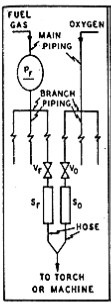 Figure Q -1
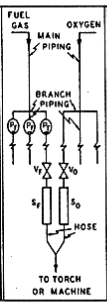 Figure Q - 2
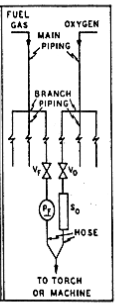 Figure Q - 3
PF — Protective equipment in fuel gas piping
SF — Backflow prevention device(s) at fuel gas station outlet
SO — Backflow prevention device(s) at oxygen
VF — Fuel gas station outlet valve
VO — Oxygen station outlet valve station outlet
437-002-2253 (13)(h)(B)(i) Backflow of oxygen into the fuel-gas supply system.
437-002-2253 (13)(h)(B)(ii) Passage of a flash back into the fuel-gas supply system.
437-002-2253 (13)(h)(B)(iii) Excessive back pressure of oxygen in the fuel-gas supply system.
Note: The three functions of the protective equipment may be combined in one device or may be provided by separate devices.
437-002-2253 (13)(h)(C) Locate protective equipment:
437-002-2253 (13)(h)(C)(i) As in Figure Q-1 in the main supply line, Figure Q-1, or
437-002-2253 (13)(h)(C)(ii) As in Figure Q-2 at the head of each branch line, or
437-002-2253 (13)(h)(C)(iii) As in Figure Q-3 at each location where fuel-gas is withdrawn.
437-002-2253 (13)(h)(C)(iv) As in Figure Q-2 or Figure Q-3 where branch lines are of 2 inch pipe size or larger or of substantial length.
437-002-2253 (13)(h)(D) Install flash-back protection that will prevent flame from passing into the fuel-gas system.
437-002-2253 (13)(h)(E) Provide an approved back-pressure relief device set at a pressure not greater than the pressure rating of the backflow or the flashback protection device, whichever is lower.
437-002-2253 (13)(h)(F) Locate pressure-relief devices on the downstream side of backflow and flashback protection devices.
437-002-2253 (13)(h)(G) Install pressure-relief device vents that are at least as large as the relief device inlet.
437-002-2253 (13)(h)(H) Install pressure-relief vents without low points that may collect moisture.
437-002-2253 (13)(h)(I) Install drip pots with drains closed with screw plugs or caps at the low points if low points are unavoidable.
437-002-2253 (13)(h)(J) Install the vent end so it:
437-002-2253 (13)(h)(J)(i) Does not endanger personnel or property through gas discharge.
437-002-2253 (13)(h)(J)(ii) Is located away from ignition sources.
437-002-2253 (13)(h)(J)(iii) Terminates in a hood or bend.
437-002-2253 (13)(h)(K) Maintain liquid levels when using a liquid in the pipeline protective equipment.
Note: Suitable antifreeze may be used to prevent freezing.
437-002-2253 (13)(h)(L) Withdraw fuel-gas for use with equipment not requiring oxygen upstream of the piping protective devices.
437-002-2253 (13)(i) Station outlet protective equipment must:
437-002-2253 (13)(i)(A) Have a check valve, pressure regulator, hydraulic seal, or combination of these devices at each station outlet, including those on portable headers.
437-002-2253 (13)(i)(B) Have these devices as shown in Figures Q-1, Q-2, and Q-3 and designated as SF and SO.
437-002-2253 (13)(i)(C) Use approved pipeline protective equipment (designated PF) located at the station outlet as in Figure Q-3, or an additional check valve, pressure regulator, or hydraulic seal is required.
437-002-2253 (13)(i)(D) Have a shutoff valve (designated VF and VO) installed at each station outlet.
437-002-2253 (13)(i)(E) Have a shutoff valve located on the upstream side of other station outlet equipment.
437-002-2253 (13)(i)(F) Terminate the station outlet in a union connection that complies with the Compressed Gas Association (CGA) Pamphlet E-1 2009, 6th Edition, Standard for Rubber Welding Hose and Hose Connections for Gas Welding, Cutting, and Allied Processes and Compressed Gas Association (CGA) Pamphlet E-4 2010, 6th Edition, Standard for Gas Pressure Regulators if the outlet is equipped with a detachable regulator.
437-002-2253 (13)(i)(G) Terminate in a union connection complying with the Compressed Gas Association (CGA) Pamphlet E-1 2009, 6th Edition, Standard for Rubber Welding Hose and Hose Connections for Gas Welding, Cutting, and Allied Processes if it is connected directly to a hose.
437-002-2253 (13)(i)(H) Terminate in pipe threads to which permanent connections are to be made, such as to a machine.
437-002-2253 (13)(i)(I) Have station outlets equipped with a detachable outlet seal cap secured in place.
437-002-2253 (13)(i)(J) Use this cap to seal the outlet except when a hose, a regulator, or piping is attached.
437-002-2253 (13)(i)(K) Be equipped with station outlets with approved backflow and flash-back protective devices when four or less torches are supplied from one station outlet through rigid piping provided:
437-002-2253 (13)(i)(K)(i) Each outlet from this piping is equipped with a shutoff valve, and
437-002-2253 (13)(i)(K)(ii) The fuel-gas capacity of any one torch does not exceed 15 cubic feet (0.42m3) per hour.
437-002-2253 (14) Acetylene generators.
437-002-2253 (14)(a) When using acetylene generators you must:
437-002-2253 (14)(a)(A) Use those that are of approved construction.
437-002-2253 (14)(a)(B) Ensure they are plainly marked with:
437-002-2253 (14)(a)(B)(i) Maximum weight and size of carbide necessary for a single charge.
437-002-2253 (14)(a)(B)(ii) Manufacturer's name and address.
437-002-2253 (14)(a)(B)(iii) Name or number of the type of generator.
437-002-2253 (14)(a)(B)(iv) Size of the carbide to be used on the generator nameplate.
437-002-2253 (14)(a)(B)(v) Rating and pressure limitations.
437-002-2253 (14)(a)(C) Limit the total hourly output rate for which it is approved and marked. Unless specifically approved for higher ratings, carbide-feed generators must be rated at 1 cubic foot (0.028 m3) per hour per pound of carbide required for a single complete charge.
437-002-2253 (14)(a)(D) Require regular operating of relief valves.
437-002-2253 (14)(a)(E) Set relief valves to open at a pressure not in excess of 15 psig.
437-002-2253 (14)(a)(F) Set hydraulic back pressure valves to open at a pressure not in excess of 20 psig.
437-002-2253 (14)(a)(G) Locate the generator where the operator can maintain ample free, unobstructed operation and maintenance space around the generator to permit ready adjustment and charging.
437-002-2253 (14)(a)(H) Ensure that all non-automatic generator water overflows are visible.
437-002-2253 (14)(a)(I) Ensure that non-automatic generators are not used to generate acetylene at pressures exceeding 1 psig.
437-002-2253 (14)(b) When using stationary acetylene generators (automatic and non-automatic) you must:
437-002-2253 (14)(b)(A) Place on a foundation where:
437-002-2253 (14)(b)(A)(i) The generator(s) is level.
437-002-2253 (14)(b)(A)(ii) No excessive strain will be placed on the generator or its connections.
437-002-2253 (14)(b)(B) Ensure the generator(s) is grounded.
437-002-2253 (14)(b)(C) Place generators where water will not freeze.
437-002-2253 (14)(b)(D) Ensure there are no prohibited sources of ignition in outside generator houses or inside generator rooms unless the generators are prepared in accordance with paragraph (h)(H)(i) through (iv) of this section:
437-002-2253 (14)(b)(E) Ensure that when a non-continuous connection to the water supply is used the supply line must terminate at a point not less than 2 inches above the regularly provided opening for filling so that the water can be observed as it enters the generator.
437-002-2253 (14)(b)(F) Discharge generators through an open connection into a suitably vented outdoor receptacle or residue pit.
Note:
An open connection for the sludge draw off is desirable to enable the generator operator to observe leakage of generator water from the drain valve or sludge cock.
437-002-2253 (14)(b)(G) Provide a vent pipe for each generator.
437-002-2253 (14)(b)(H) Rigidly install the escape or relief pipe:
437-002-2253 (14)(b)(H)(i) Without traps.
437-002-2253 (14)(b)(H)(ii) So condensation will drain back to the generator.
437-002-2253 (14)(b)(I) Carry the full size escape or relief pipe to a suitable point outside the building.
437-002-2253 (14)(b)(J) Terminate the escape or relief pipe in a hood or bend located at least 12 feet (3.7m) above the ground.
Note: It is preferable to terminate the escape or relief pipe above the roof, and as far away as practicable from windows or other openings into buildings and as far away as practicable from sources of ignition such as flues or chimneys and tracks used by locomotives.
437-002-2253 (14)(b)(K) Route the generating chamber relief pipes separately to the outside so they are unobstructed by rain, snow, ice, insects, or birds.
437-002-2253 (14)(b)(L) Locate the end of the relief pipes at least 3 feet (0.9 m) from combustible construction.
437-002-2253 (14)(b)(M) Use gas holders constructed on the gasometer principle that has the bell suitably guided.
437-002-2253 (14)(b)(N) Ensure the gas bell moves freely without tendency to bind and it has at least 2 inches (5 cm) clearance from the shell.
437-002-2253 (14)(b)(O) Provide a compressor or booster cutoff at a point 12 inches (0.3 m) or more above the landing point of the bell.
437-002-2253 (14)(b)(P) Ventilate the room in accordance with paragraph (d)(J) of this section when the gas holder is located indoors.
437-002-2253 (14)(b)(Q) Heat and light the room in accordance with paragraphs (d)(K) and (d)(L), (M), (N), (O), and (P) of this section when the gas holder is located indoors.
437-002-2253 (14)(b)(R) Protect gas holder seals against freezing when the gas holder is not located within a heated building.
437-002-2253 (14)(b)(S) Provide means to stop the generator-feeding mechanism before the gas holder reaches the upper limit of its travel.
437-002-2253 (14)(b)(T) Ensure that the gas capacity of the gas holder is not less than one-third of the hourly rating of the generator when the holder is connected to only one generator.
437-002-2253 (14)(b)(U) Ensure if acetylene is used from the gas holder without increase in pressure at some points, but with increase in pressure by a compressor or booster pump at other points, then you must:
437-002-2253 (14)(b)(U)(i) Install approved piping protective devices in each supply line.
437-002-2253 (14)(b)(U)(ii) Locate a low-pressure protective device between the gas holder and the shop piping.
437-002-2253 (14)(b)(U)(iii) Locate the medium-pressure protective device between the compressor or booster pump and the shop piping (see Figure 1).
Note 1: Approved protective equipment (designated PF) is used to prevent backflow of oxygen into the fuel-gas supply system, passage of a flashback into the fuel-gas supply system; and excessive back pressure of oxygen in the fuel-gas supply system.
Note 2: The three functions of the protective equipment may be combined in one device or may be provided by separate devices.
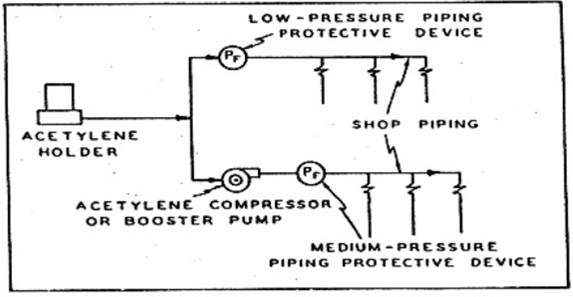 Figure 1
437-002-2253 (14)(b)(V) Use approved compressor or booster systems only.
437-002-2253 (14)(b)(W) Ensure that wiring and electrical equipment in compressor or booster pump rooms or enclosures conform to the provisions of Subdivision S, Electrical, Class I, Division 2.
437-002-2253 (14)(b)(X) Locate compressors and booster pump equipment:
437-002-2253 (14)(b)(X)(i) In well-ventilated areas and
437-002-2253 (14)(b)(X)(ii) Away from ignition sources including, but not limited to, open flames, electrical or mechanical sparks.
437-002-2253 (14)(b)(Y) Provide compressor or booster pumps with pressure relief valves which will relieve pressure exceeding 15 psig:
437-002-2253 (14)(b)(Y)(i) To a safe outdoor location as provided in paragraph (b)(G), (H), (I), (J), (K), and (L) of this section, or
437-002-2253 (14)(b)(Y)(ii) By returning the gas to the inlet side or to the gas supply source.
437-002-2253 (14)(b)(Z) Provide compressor or booster pump discharge outlets with approved protective equipment. (See Service Piping Systems (h) and (i)).
437-002-2253 (14)(c) When using stationary acetylene generators (automatic and non-automatic) you must not:
437-002-2253 (14)(c)(A) Use common salt (sodium chloride) or other corrosive chemicals for protection against freezing.
437-002-2253 (14)(c)(B) Supply water through a continuous connection to the generator unless the generator is provided with an:
437-002-2253 (14)(c)(B)(i) Adequate open overflow, or
437-002-2253 (14)(c)(B)(ii) Automatic water shutoff which will effectively prevent overfilling the generator.
437-002-2253 (14)(c)(C) Fit generators with continuous drain connections leading to sewers unless otherwise specifically approved.
437-002-2253 (14)(c)(D) Interconnect generating chamber relief pipes.
437-002-2253 (14)(d) When outside generator houses and inside generator rooms for stationary acetylene generators are used, you must:
437-002-2253 (14)(d)(A) Ensure that the walls, floors, and roofs of outside generator houses are of noncombustible construction.
437-002-2253 (14)(d)(B) Separate the storage or manifolding of oxygen cylinders from the generator or carbide storage section by partition walls continuous from floor to roof or ceiling, of the type of construction stated in paragraph (d)(H)(i) thru (iii) of this section.
437-002-2253 (14)(d)(C) Ensure that separation walls are:
437-002-2253 (14)(d)(C)(i) Without openings.
437-002-2253 (14)(d)(C)(ii) Joined to the floor, other walls and ceiling or roof in a manner to create a permanent gastight joint.
437-002-2253 (14)(d)(D) Locate exit doors so they are readily accessible in case of emergency.
437-002-2253 (14)(d)(E) Provide explosion venting:
437-002-2253 (14)(d)(E)(i) For outside generator houses and inside generator rooms in exterior walls or roofs.
437-002-2253 (14)(d)(E)(ii) In areas equal to not less than 1 square foot (0.09 m2) per 50 cubic feet (1.4 m3) of room volume.
437-002-2253 (14)(d)(E)(iii) That consists of one or any combination of the following:
437-002-2253 (14)(d)(E)(iii)(I) Walls of light, noncombustible material preferably single-thickness,
437-002-2253 (14)(d)(E)(iii)(II) Single-strength glass;
437-002-2253 (14)(d)(E)(iii)(III) Lightly fastened hatch covers;
437-002-2253 (14)(d)(E)(iii)(IV) Lightly fastened swinging doors in exterior walls opening outward;
437-002-2253 (14)(d)(E)(iii)(V) Lightly fastened walls or roof designed to relieve at a maximum pressure of 25 pounds per square foot (0.001 MPa).
437-002-2253 (14)(d)(F) Restrict the installation of acetylene generators inside buildings to buildings not exceeding one story in height.
Note: This does not prohibit such installation on the roof or top floor of a building exceeding such height.
437-002-2253 (14)(d)(G) Enclose generators installed inside a building in a separate room.
437-002-2253 (14)(d)(H) Ensure that the walls, partitions, floors, and ceilings of inside generator rooms:
437-002-2253 (14)(d)(H)(i) Are constructed from noncombustible materials having a fire-resistance rating of at least 1 hour floor to ceiling.
437-002-2253 (14)(d)(H)(ii) Are securely anchored.
437-002-2253 (14)(d)(H)(iii) Have at least one wall of the room be an exterior wall.
437-002-2253 (14)(d)(I) Protect openings from an inside generator room to other parts of the building:
437-002-2253 (14)(d)(I)(i) By a swinging type, self-closing fire door for a Class B opening and having a rating of at least 1 hour.
437-002-2253 (14)(d)(I)(ii) With wired glass windows in partitions that are in approved metal frames with fixed sash.
437-002-2253 (14)(d)(I)(iii) By completing Installation in accordance with the Standard for the Installation of Fire Doors and Windows, NFPA 80-1970.
Note: Inside generator rooms built after July 1, 2014 must comply with NFPA 80-2013.
437-002-2253 (14)(d)(J) Ventilate inside generator rooms or outside generator houses with vents located at floor and ceiling levels.
437-002-2253 (14)(d)(K) Heat by steam, hot water, enclosed electrically heated elements or other indirect means.
437-002-2253 (14)(d)(L) Ensure that generator houses or rooms have natural light during daylight hours.
437-002-2253 (14)(d)(M) Restrict installation of electric lamps to fixed position where artificial lighting is necessary.
437-002-2253 (14)(d)(N) Provide lamps with enclosures of glass or other noncombustible material so designed and constructed to prevent gas vapors from reaching the lamp or socket and to resist breakage.
437-002-2253 (14)(d)(O) Use rigid conduit with threaded connections.
437-002-2253 (14)(d)(P) Install lamps outside of wired-glass panels in gas-tight frames in the exterior walls or roof of the generator house or room.
437-002-2253 (14)(d)(Q) Locate electric switches, telephones, and all other electrical apparatus which may cause a spark, outside the generator house or in a room or space separated from the generator room by a gas-tight partition, except:
437-002-2253 (14)(d)(Q)(i) If they are specifically approved for use inside acetylene generator room.
437-002-2253 (14)(d)(Q)(ii) Where the generator system is designed so that no carbide fill opening or other part of the generator is open to the generator house or room during the operation of the generator, and
437-002-2253 (14)(d)(Q)(iii) When residue is carried in closed piping from the residue discharge valve to a point outside the generator house or room, and
437-002-2253 (14)(d)(Q)(iv) Where electrical equipment in the generator house or room must conform to the provisions of Subpart S for Class I, Division 2 locations.
437-002-2253 (14)(d)(R) Ensure that unauthorized persons do not enter outside generator houses or inside generator rooms.
437-002-2253 (14)(e) When outside generator houses and inside generator rooms for stationary acetylene generators are used, you must not:
437-002-2253 (14)(e)(A) Locate openings in any outside generator house within 5 feet (1.5m) of any opening in another building.
437-002-2253 (14)(e)(B) Use flames or fire to heat outside generator houses or inside generator rooms, or in any enclosure communicating with them.
437-002-2253 (14)(f) When using portable acetylene generators you must:
437-002-2253 (14)(f)(A) Use those that are approved for portable use.
437-002-2253 (14)(f)(B) Use them further than 10 feet (3m) from combustible materials other than the floor.
437-002-2253 (14)(f)(C) Protect them against freezing.
437-002-2253 (14)(f)(D) Clean and recharge them and blow off the air mixture outside of buildings.
437-002-2253 (14)(f)(E) Anchor them to the vehicles they are to be transported and used on.
437-002-2253 (14)(f)(F) Turn off the vehicle motor during charging, cleaning, and generating processes.
437-002-2253 (14)(f)(G) Locate portable generators at a safe distance from the welding position so they will not be exposed to sparks, slag, and misdirection of the torch flame or over heating from hot materials or processes.
437-002-2253 (14)(g) When using portable acetylene generators you must not:
437-002-2253 (14)(g)(A) Use them in rooms with:
437-002-2253 (14)(g)(A)(i) A total volume less than the total gas-generating capacity per charge of all generators in the room (to obtain the gas-generating capacity in cubic feet per charge, multiply the pounds of carbide per charge by 4.5).
437-002-2253 (14)(g)(A)(ii) A ceiling height less than 10 feet (3 m).
437-002-2253 (14)(g)(B) Use salt or other corrosive chemical to prevent freezing.
437-002-2253 (14)(g)(C) Move those charged with carbide by crane or derrick.
437-002-2253 (14)(g)(D) Store those not in use in rooms where open flames are used unless the:
437-002-2253 (14)(g)(D)(i) Generator contains no carbide.
437-002-2253 (14)(g)(D)(ii) Generator has been thoroughly purged of acetylene.
437-002-2253 (14)(g)(D)(iii) Rooms are well ventilated.
437-002-2253 (14)(h) When providing maintenance and operating acetylene generators you must:
437-002-2253 (14)(h)(A) Post operating instructions in a conspicuous place near the generator or keep those in a suitable place available for ready reference.
437-002-2253 (14)(h)(B) Follow the order of operations specified in the manufacturer instructions when recharging generators.
437-002-2253 (14)(h)(C) Flush out batch-type generators with water:
437-002-2253 (14)(h)(C)(i) When the charge of carbide is exhausted.
437-002-2253 (14)(h)(C)(ii) Before additional carbide is added to the generating chamber, and
437-002-2253 (14)(h)(D) Renew the water supply according to instruction card furnished by the manufacturer.
437-002-2253 (14)(h)(E) Add enough carbide each time the generator is recharged to refill the space provided for carbide without ramming the charge.
437-002-2253 (14)(h)(F) Keep the generator water chambers filled to the proper level at all times except while draining during the recharging operation.
437-002-2253 (14)(h)(G) Fill the water chamber to the proper level whenever:
437-002-2253 (14)(h)(G)(i) Repairs are to be made.
437-002-2253 (14)(h)(G)(ii) The generator is to be charged.
437-002-2253 (14)(h)(G)(iii) Carbide is to be removed.
437-002-2253 (14)(h)(H) Do the following before making repairs involving welding, soldering, or other hot work or other operations which produce a source of ignition:
437-002-2253 (14)(h)(H)(i) Completely remove the carbide charge and feed mechanism.
437-002-2253 (14)(h)(H)(ii) Expel all acetylene by completely flooding the generator shell with water.
437-002-2253 (14)(h)(H)(iii) Disconnect the generator from the piping system.
437-002-2253 (14)(h)(H)(iv) Keep the generator filled with water, if possible, or positioned to hold as much water as possible.
437-002-2253 (14)(i) When maintaining or operating acetylene generators you must not:
437-002-2253 (14)(i)(A) Discharge water-carbide residue from the generator:
437-002-2253 (14)(i)(A)(i) Into sewer pipes, or
437-002-2253 (14)(i)(A)(ii) Store in areas near open flames.
Note: Clear water from residue settling pits may be discharged into sewer pipes.
437-002-2253 (14)(i)(B) Use steel or ferrous tools while distributing the charge.
437-002-2253 (14)(i)(C) Make hot repairs in a room where there are other generators unless all the generators and piping have been purged of acetylene.
437-002-2253 (15) Storing of calcium carbide.
437-002-2253 (15)(a) Packaging of calcium carbide must:
437-002-2253 (15)(a)(A) Be in containers that are:
437-002-2253 (15)(a)(A)(i) Constructed from metal having sufficient strength to prevent rupture.
437-002-2253 (15)(a)(A)(ii) Equipped with a screw top or equivalent.
437-002-2253 (15)(a)(A)(iii) Constructed to be water-and-air-tight.
437-002-2253 (15)(a)(A)(iv) Soldered in a manner that the package will not fail if exposed to fire.
437-002-2253 (15)(a)(B) Ensure that the packages are conspicuously marked "Calcium Carbide – Dangerous If Not Kept Dry" or with equivalent warning.
437-002-2253 (15)(a)(C) Make known this caution: "Metal tools, even the so-called spark resistant type may cause ignition of an acetylene and air mixture when opening carbide containers".
437-002-2253 (15)(b) When storing calcium carbide indoors you must:
437-002-2253 (15)(b)(A) Store in dry, waterproof, well-ventilated locations when quantities of 600 pounds or less are being stored.
437-002-2253 (15)(b)(B) Keep packages of calcium carbide sealed, except one of each size may be open.
437-002-2253 (15)(b)(C) Store calcium carbide exceeding 600 pounds (272.2 kg) but not exceeding 5,000 pounds (2,268 kg):
437-002-2253 (15)(b)(C)(i) In accordance with paragraph (b)(D)(i), (ii), (I) through (III) of this section;
437-002-2253 (15)(b)(C)(ii) In an inside generator room or outside generator house; or
437-002-2253 (15)(b)(C)(iii) In a separate room in a one-story building which may contain other occupancies, but without cellar or basement beneath the carbide storage section. Such rooms must be constructed in accordance with paragraphs (d)(H)(i) through (iii) and (d)(I)(i) and (ii) of this section and ventilated in accordance with paragraph (d)(J) of this section. These rooms must be used for no other purpose.
437-002-2253 (15)(b)(D) Store calcium carbide in excess of 5,000 pounds (2,268 kg) in:
437-002-2253 (15)(b)(D)(i) An outside generator houses, or
437-002-2253 (15)(b)(D)(ii) A one story building without cellar or basement and used for no other purpose:
437-002-2253 (15)(b)(D)(ii)(I) If the storage building is of noncombustible construction, it may adjoin other one-story buildings if they are separated by unpierced firewalls.
437-002-2253 (15)(b)(D)(ii)(II) If the storage building is detached and less than 10 feet (3 m) from a building or buildings, there must not be an opening in any of the mutually exposing sides of such buildings within 10 feet (3 m).
437-002-2253 (15)(b)(D)(ii)(III) If the storage building is of combustible construction, it must be at least 30 feet (9.1 m) from any other building exceeding two stories.
437-002-2253 (15)(c) When storing calcium carbide indoors you must not:
437-002-2253 (15)(c)(A) Store more than 600 pounds of calcium carbide in the same room with fuel-gas cylinders.
437-002-2253 (15)(c)(B) Break the seals when there is carbide in excess of 1 pound (0.5 kg) in any other unsealed package of the same size of carbide in the room.
437-002-2253 (15)(c)(C) Store in rooms with sprinkler systems.
437-002-2253 (15)(d) When storing calcium carbide outdoors you must:
437-002-2253 (15)(d)(A) Examine carbide containers to make sure they are in good condition.
437-002-2253 (15)(d)(B) Place the bottom tier of each row on wooden planking or equivalent so containers will not contact the ground or ground water.
437-002-2253 (15)(d)(C) Periodically re-examine carbide containers for rusting or other damage that might affect its water or air tightness.
437-002-2253 (15)(d)(D) Ensure the carbide containers that are stored the longest are used first.
437-002-2253 (15)(d)(E) Only store in unopened air and water tight metal containers.
437-002-2253 (15)(d)(F) Store only those containers that are unopened.
Statutory Authority: ORS 654.025(2) and ORS 656.726(4).
Statutes Implemented: ORS 654.001 to 654.295.
History:
OSHA Administrative Order 6-2014, filed 10/28/2014, effective 5/1/2015.
End Oregon-initiated rule.
1910.254 Arc Welding and Cutting
1910.254 (a) General.
1910.254 (a)(1) Equipment selection. Welding equipment shall be chosen for safe application to the work to be done as specified in paragraph (b) of this section.
1910.254 (a)(2) Installation. Welding equipment shall be installed safely as specified by paragraph (c) of this section.
1910.254 (a)(3) Instruction. Workmen designated to operate arc welding equipment shall have been properly instructed and qualified to operate such equipment as specified in paragraph (d) of this section.
1910.254 (b) Application of arc welding equipment.
1910.254 (b)(1) General. Assurance of consideration of safety in design is obtainable by choosing apparatus complying with the Requirements for Electric Arc-Welding Apparatus, NEMA EW-1-1962, National Electrical Manufacturers Association or the Safety Standard for Transformer-Type Arc-Welding Machines, ANSI C33.2-1956, Underwriters' Laboratories, both of which are incorporated by reference as specified in 1910.6.
1910.254 (b)(2) Environmental conditions.
1910.254 (b)(2)(i) Standard machines for arc welding service shall be designed and constructed to carry their rated load with rated temperature rises where the temperature of the cooling air does not exceed 40° C (104° F) and where the altitude does not exceed 3,300 feet (1,005.8 m), and shall be suitable for operation in atmospheres containing gases, dust, and light rays produced by the welding arc.
1910.254 (b)(2)(ii) Unusual service conditions may exist, and in such circumstances machines shall be especially designed to safely meet the requirements of the service. Chief among these conditions are:
1910.254 (b)(2)(ii)(A) Exposure to unusually corrosive fumes.
1910.254 (b)(2)(ii)(B) Exposure to steam or excessive humidity.
1910.254 (b)(2)(ii)(C) Exposure to excessive oil vapor.
1910.254 (b)(2)(ii)(D) Exposure to flammable gases.
1910.254 (b)(2)(ii)(E) Exposure to abnormal vibration or shock.
1910.254 (b)(2)(ii)(F) Exposure to excessive dust.
1910.254 (b)(2)(ii)(G) Exposure to weather.
1910.254 (b)(2)(ii)(H) Exposure to unusual seacoast or shipboard conditions.
1910.254 (b)(3) Voltage. The following limits shall not be exceeded:
1910.254 (b)(3)(i) Alternating-current machines.
1910.254 (b)(3)(i)(A) Manual arc welding and cutting – 80 volts.
1910.254 (b)(3)(i)(B) Automatic (machine or mechanized) arc welding and cutting – 100 volts.
1910.254 (b)(3)(ii) Direct-current machines.
1910.254 (b)(3)(ii)(A) Manual arc welding and cutting – 100 volts.
1910.254 (b)(3)(ii)(B) Automatic (machine or mechanized) arc welding and cutting – 100 volts.
1910.254 (b)(3)(iii) When special welding and cutting processes require values of open circuit voltages higher than the above, means shall be provided to prevent the operator from making accidental contact with the high voltage by adequate insulation or other means.
1910.254 (b)(3)(iv) For a. c. welding under wet conditions or warm surroundings where perspiration is a factor, the use of reliable automatic controls for reducing no load voltage is recommended to reduce the shock hazard.
1910.254 (b)(4) Design.
1910.254 (b)(4)(i) A controller integrally mounted in an electric motor driven welder shall have capacity for carrying rated motor current, shall be capable of making and interrupting stalled rotor current of the motor, and may serve as the running overcurrent device if provided with the number of overcurrent units as specified by Subpart S of this part.
1910.254 (b)(4)(ii) On all types of arc welding machines, control apparatus shall be enclosed except for the operating wheels, levers, or handles.
1910.254 (b)(4)(iii) Input power terminals, tap change devices and live metal parts connected to input circuits shall be completely enclosed and accessible only by means of tools.
1910.254 (b)(4)(iv) Terminals for welding leads should be protected from accidental electrical contact by personnel or by metal objects, i.e., vehicles, crane hooks, etc. Protection may be obtained by use of: Dead-front receptacles for plug connections; recessed openings with nonremovable hinged covers; heavy insulating sleeving or taping or other equivalent electrical and mechanical protection. If a welding lead terminal which is intended to be used exclusively for connection to the work is connected to the grounded enclosure, it must be done by a conductor at least two AWG sizes smaller than the grounding conductor and the terminal shall be marked to indicate that it is grounded.
1910.254 (b)(4)(v) No connections for portable control devices such as push buttons to be carried by the operator shall be connected to an a.c. circuit of higher than 120 volts. Exposed metal parts of portable control devices operating on circuits above 50 volts shall be grounded by a grounding conductor in the control cable.
1910.254 (b)(4)(vi) Auto transformers or a.c. reactors shall not be used to draw welding current directly from any a.c. power source having a voltage exceeding 80 volts.
1910.254 (c) Installation of arc welding equipment.
1910.254 (c)(1) General. Installation including power supply shall be in accordance with the requirements of Subpart S of this part.
1910.254 (c)(2) Grounding.
1910.254 (c)(2)(i) The frame or case of the welding machine (except engine-driven machines) shall be grounded under the conditions and according to the methods prescribed in Subpart S of this part.
1910.254 (c)(2)(ii) Conduits containing electrical conductors shall not be used for completing a work-lead circuit. Pipelines shall not be used as a permanent part of a work-lead circuit, but may be used during construction, extension or repair providing current is not carried through threaded joints, flanged bolted joints, or caulked joints and that special precautions are used to avoid sparking at connection of the work-lead cable.
1910.254 (c)(2)(iii) Chains, wire ropes, cranes, hoists, and elevators shall not be used to carry welding current.
1910.254 (c)(2)(iv) Where a structure, conveyor or fixture is regularly employed as a welding current return circuit, joints shall be bonded or provided with adequate current collecting devices.
1910.254 (c)(2)(v) All ground connections shall be checked to determine that they are mechanically strong and electrically adequate for the required current.
1910.254 (c)(3) Supply connections and conductors.
1910.254 (c)(3)(i) A disconnecting switch or controller shall be provided at or near each welding machine which is not equipped with such a switch or controller mounted as an integral part of the machine. The switch shall be in accordance with Subpart S of this part. Overcurrent protection shall be provided as specified in Subpart S of this part. A disconnect switch with overload protection or equivalent disconnect and protection means, permitted by Subpart S of this part, shall be provided for each outlet intended for connection to a portable welding machine.
1910.254 (c)(3)(ii) For individual welding machines, the rated current-carrying capacity of the supply conductors shall be not less than the rated primary current of the welding machines.
1910.254 (c)(3)(iii) For groups of welding machines, the rated current-carrying capacity of conductors may be less than the sum of the rated primary currents of the welding machines supplied. The conductor rating shall be determined in each case according to the machine loading based on the use to be made of each welding machine and the allowance permissible in the event that all the welding machines supplied by the conductors will not be in use at the same time.
1910.254 (c)(3)(iv) In operations involving several welders on one structure, d.c. welding process requirements may require the use of both polarities; or supply circuit limitations for a.c. welding may require distribution of machines among the phases of the supply circuit. In such cases no load voltages between electrode holders will be 2 times normal in d.c. or 1, 1.41, 1.73, or 2 times normal on a.c. machines. Similar voltage differences will exist if both a.c. and d.c. welding are done on the same structure.
1910.254 (c)(3)(iv)(A) All d.c. machines shall be connected with the same polarity.
1910.254 (c)(3)(iv)(B) All a.c. machines shall be connected to the same phase of the supply circuit and with the same instantaneous polarity.
1910.254 (d) Operation and maintenance.
1910.254 (d)(1) General. Workers assigned to operate or maintain arc welding equipment shall be acquainted with the requirements of this section and with 1910.252(a), (b) and (c) of this part.
1910.254 (d)(2) Machine hook up. Before starting operations all connections to the machine shall be checked to make certain they are properly made. The work lead shall be firmly attached to the work; magnetic work clamps shall be freed from adherent metal particles of spatter on contact surfaces. Coiled welding cable shall be spread out before use to avoid serious overheating and damage to insulation.
1910.254 (d)(3) Grounding. Grounding of the welding machine frame shall be checked. Special attention shall be given to safety ground connections of portable machines.
1910.254 (d)(4) Leaks. There shall be no leaks of cooling water, shielding gas or engine fuel.
1910.254 (d)(5) Switches. It shall be determined that proper switching equipment for shutting down the machines is provided.
1910.254 (d)(6) Manufacturers' instructions. Printed rules and instructions covering operation of equipment supplied by the manufacturers shall be strictly followed.
1910.254 (d)(7) Electrode holders. Electrode holders when not in use shall be so placed that they cannot make electrical contact with persons, conducting objects, fuel or compressed gas tanks.
1910.254 (d)(8) Electric shock. Cables with splices within 10 feet (3 m) of the holder shall not be used. The welder should not coil or loop welding electrode cable around parts of his body.
1910.254 (d)(9) Maintenance.
1910.254 (d)(9)(i) The operator should report any equipment defect or safety hazard to his supervisor and the use of the equipment shall be discontinued until its safety has been assured. Repairs shall be made only by qualified personnel.
1910.254 (d)(9)(ii) Machines which have become wet shall be thoroughly dried and tested before being used.
1910.254 (d)(9)(iii) Cables with damaged insulation or exposed bare conductors shall be replaced. Joining lengths of work and electrode cables shall be done by the use of connecting means specifically intended for the purpose. The connecting means shall have insulation adequate for the service conditions.
[55 FR 13696, Apr. 11, 1990, as amended at 61 FR 9241, Mar. 7, 1996; 70 FR 53929, Sept. 13, 2005]
Statutory Authority: ORS 654.025(2) and ORS 656.726(4).
Statutes Implemented: ORS 654.001 through 654.295.
History:
OSHA Administrative Order 23-1990, filed 9/28/1990, effective 12/1/1990.
OSHA Administrative Order 4-1997, filed 4/2/1997, effective 4/2/1997.
OSHA Administrative Order 4-2005, filed 12/14/2005, effective 12/14/2005.
1910.255 Resistance Welding
1910.255 (a) General
1910.255 (a)(1) Installation. All equipment shall be installed by a qualified electrician in conformance with Subpart S of this part. There shall be a safety-type disconnecting switch or a circuit breaker or circuit interrupter to open each power circuit to the machine, conveniently located at or near the machine, so that the power can be shut off when the machine or its controls are to be serviced.
1910.255 (a)(2) Thermal protection. Ignitron tubes used in resistance welding equipment shall be equipped with a thermal protection switch.
1910.255 (a)(3) Personnel. Workmen designated to operate resistance welding equipment shall have been properly instructed and judged competent to operate such equipment.
1910.255 (a)(4) Guarding. Controls of all automatic or air and hydraulic clamps shall be arranged or guarded to prevent the operator from accidentally activating them.
1910.255 (b) Spot and seam welding machines (nonportable).
1910.255 (b)(1) Voltage. All external weld initiating control circuits shall operate on low voltage, not over 120 volts, for the safety of the operators.
1910.255 (b)(2) Capacitor welding. Stored energy or capacitor discharge type of resistance welding equipment and control panels involving high voltage (over 550 volts) shall be suitably insulated and protected by complete enclosures, all doors of which shall be provided with suitable interlocks and contacts wired into the control circuit (similar to elevator interlocks). Such interlocks or contacts shall be so designed as to effectively interrupt power and short circuit all capacitors when the door or panel is open. A manually operated switch or suitable positive device shall be installed, in addition to the mechanical interlocks or contacts, as an added safety measure assuring absolute discharge of all capacitors.
1910.255 (b)(3) Interlocks. All doors and access panels of all resistance welding machines and control panels shall be kept locked and interlocked to prevent access, by unauthorized persons, to live portions of the equipment.
1910.255 (b)(4) Guarding. All press welding machine operations, where there is a possibility of the operator's fingers being under the point of operation shall be effectively guarded by the use of a device such as an electronic eye safety circuit, two hand controls or protection similar to that prescribed for punch press operation, 1910.217 of this part. All chains, gears, operating bus linkage, and belts shall be protected by adequate guards, in accordance with 1910.219 of this part.
1910.255 (b)(5) Shields. The hazard of flying sparks shall be, wherever practical, eliminated by installing a shield guard of safety glass or suitable fire-resistant plastic at the point of operation. Additional shields or curtains shall be installed as necessary to protect passing persons from flying sparks. (See 1910.252(b)(2)(i)(C) of this part.)
1910.255 (b)(6) Foot switches. All foot switches shall be guarded to prevent accidental operation of the machine.
1910.255 (b)(7) Stop buttons. Two or more safety emergency stop buttons shall be provided on all special multispot welding machines, including 2-post and 4-post weld presses.
1910.255 (b)(8) Safety pins. On large machines, four safety pins with plugs and receptacles (one in each corner) shall be provided so that when safety pins are removed and inserted in the ram or platen, the press becomes inoperative.
1910.255 (b)(9) Grounding. Where technically practical, the secondary of all welding transformers used in multispot, projection and seam welding machines shall be grounded. This may be done by permanently grounding one side of the welding secondary current circuit. Where not technically practical, a center tapped grounding reactor connected across the secondary or the use of a safety disconnect switch in conjunction with the welding control are acceptable alternates. Safety disconnect shall be arranged to open both sides of the line when welding current is not present.
1910.255 (c) Portable welding machines.
1910.255 (c)(1) Counterbalance. All portable welding guns shall have suitable counterbalanced devices for supporting the guns, including cables, unless the design of the gun or fixture makes counterbalancing impractical or unnecessary.
1910.255 (c)(2) Safety chains. All portable welding guns, transformers and related equipment that is suspended from overhead structures, eye beams, trolleys, etc., shall be equipped with safety chains or cables. Safety chains or cables shall be capable of supporting the total shock load in the event of failure of any component of the supporting system.
1910.255 (c)(3) Clevis. Each clevis shall be capable of supporting the total shock load of the suspended equipment in the event of trolley failure.
1910.255 (c)(4) Switch guards. All initiating switches, including retraction and dual schedule switches, located on the portable welding gun shall be equipped with suitable guards capable of preventing accidental initiation through contact with fixturing, operator's clothing, etc. Initiating switch voltage shall not exceed 24 volts.
1910.255 (c)(5) Moving holder. The movable holder, where it enters the gun frame, shall have sufficient clearance to prevent the shearing of fingers carelessly placed on the operating movable holder.
1910.255 (c)(6) Grounding. The secondary and case of all portable welding transformers shall be grounded. Secondary grounding may be by center tapped secondary or by a center tapped grounding reactor connected across the secondary.
1910.255 (d) Flash welding equipment.
1910.255 (d)(1) Ventilation and flash guard. Flash welding machines shall be equipped with a hood to control flying flash. In cases of high production, where materials may contain a film of oil and where toxic elements and metal fumes are given off, ventilation shall be provided in accordance with 1910.252(c) of this part.
1910.255 (d)(2) Fire curtains. For the protection of the operators of nearby equipment, fire-resistant curtains or suitable shields shall be set up around the machine and in such a manner that the operators movements are not hampered.
1910.255 (e) Maintenance. Periodic inspection shall be made by qualified maintenance personnel, and a certification record maintained. The certification record shall include the date of inspection, the signature of the person who performed the inspection and the serial number, or other identifier, for the equipment inspected. The operator shall be instructed to report any equipment defects to his supervisor and the use of the equipment shall be discontinued until safety repairs have been completed.
[39 FR 23502, June 27, 1974, as amended at 40 FR 18426, Apr. 28, 1975; 55 FR 13710, Apr. 11, 1990.]
Statutory Authority: ORS 654.025(2) and ORS 656.726(3).
History:
OSHA Administrative Order 23-1990, filed 9/28/1990, effective 12/1/1990.